Featured on @StorylineReddit: November 15, 2025
The Man Who Manufactured His Own Permission
Max described his decision to move in with his ex-wife as selflessness, but the Reddit fiancé ex-wife cancer story reveals a man who lied to every person who trusted him. He upgraded a stage 2 diagnosis to stage 4 before presenting it to his fiancée, while Caroline heard that the wedding had been pushed to August. Both women received assurances that the other fully supported his arrangement. Each fabrication served a single purpose: removing the possibility of objection. Questioning a man who tends to a dying woman costs social capital most people refuse to spend. Max calibrated for exactly that reluctance.
Calling this a love triangle misreads the blueprint. Max was not caught between two people pulling in opposite directions. He built a corridor that led exactly where he wanted to go, then told each woman she was standing at the only possible exit. The compassion was real in its raw materials. Every load-bearing wall, though, was constructed from fabrication. Max did not choose between two women. He chose a version of himself that required both of them to remain uninformed.
A Fiancé’s Load-Bearing Lies
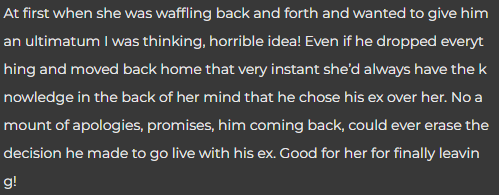
Max’s first lie was the foundation for every lie that followed. By inflating Caroline’s diagnosis from stage 2 to stage 4, he pre-empted every reasonable objection his fiancée might raise. A stage 2 diagnosis invites questions about proportionality. Stage 4 shuts them down. OOP could not weigh her discomfort against a woman’s imminent death without sounding monstrous, and Max understood that calculus before he ever picked up the phone.
The second layer required its own maintenance. When he warned OOP not to mention the staging around Caroline because she was “extremely sensitive,” he sealed the information gap between both women. That instruction sounded like compassion. It functioned as a firewall.
From there, each subsequent decision locked into place with mechanical precision. Moving from a hotel to her sofa became inevitable once the timeline stretched. Skype calls dropped from daily to twice a week. OOP agreed to every escalation because each one appeared to grow organically from the last. The wedding postponement landed not as an alarm but as the next logical concession in a sequence that had already absorbed so many.
The Moment the Structure Collapsed
OOP’s phone call introduced a variable Max had not engineered for: compromise. She offered flight schedules, a spare bedroom, a postponed honeymoon redirected into plane tickets. These were practical solutions to a practical problem. Max could not accept any of them without exposing that the problem had never been practical. His confession arrived not from guilt but from architectural necessity. The lies had run out of room.
The typical Reddit fiancé ex-wife cancer narrative would end with the discovery of an affair. This one ends with something more disorienting: a man who built parallel fictions for two women and maintained them with administrative precision. His flatline response to the breakup confirmed what OOP only recognized in retrospect. He had not been holding on. He had been managing a controlled departure.


The Architecture of Permission
Max did not stumble into deception. He engineered it with load-bearing specificity. Changing “stage 2” to “stage 4” was not an exaggeration born of panic. It was a structural decision that governed everything built on top of it. Stage 4 breast cancer carries a five-year survival rate below 30 percent. Stage 2 sits closer to 90. The gap between those numbers is the gap between a fiancée who asks hard questions and one who swallows her discomfort in silence.
Every subsequent lie required the first one to hold. When Max told OOP not to mention the staging around Caroline, he framed it as emotional caretaking. In practice, it prevented the two women from exchanging a single piece of verifiable information. OOP could not confirm the diagnosis with Caroline. Caroline could not learn that a January wedding existed. Max positioned himself as the sole translator between two realities, and neither audience had reason to request a second source.
Permits Built on Permits
The hotel became a sofa. Daily Skype became twice-weekly Skype. A two-week visit became an open-ended relocation. Each escalation arrived pre-justified by the one before it. OOP approved every step because refusing any single concession meant refusing all of them, and refusing all of them meant abandoning a dying woman. Max had arranged the sequence so that mercy only flowed in one direction.
Compassion as Currency
Before he left, Max told OOP: “We’ve got our whole lives to spend together. She might only have a year.” That sentence performed generosity while functioning as a gag order. Any protest OOP raised would position her as the person who valued a wedding date over a woman’s life. Max had converted empathy into a resource he alone could spend, and he spent it to purchase silence.
The Reddit fiancé ex-wife cancer dynamic played on a specific vulnerability. OOP described feeling guilt alongside her anger, as though the two emotions cancelled each other out. They did not cancel. The guilt suppressed the anger. Max had arranged exactly that suppression by selecting a crisis severe enough to make objection feel cruel. OOP’s compassion became the instrument of her own sidelining.
Two Women, Two Scripts, One Playwright
Caroline received her own custom fiction. Max told her the wedding had been postponed to August. He told her OOP fully supported his extended stay. Caroline, dealing with surgery and chemotherapy, had no reason to doubt a man who had shown up at her door offering help. She even gave him explicit permission to leave after her surgery, telling him she did not want to pressure him. He refused, then reported to OOP that Caroline needed him desperately.
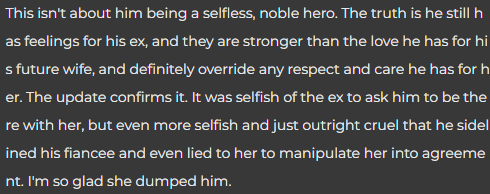
Both women acted reasonably given the information they possessed. Neither possessed accurate information. Max alone held the complete picture, and he maintained that monopoly through careful partitioning. His impulse to support someone facing cancer was not corrupt in itself. Plenty of people rearrange their lives for a former partner in crisis, and the choice can be defensible. The failure was his refusal to let OOP participate in that decision with honest data. He did not trust her to agree, so he removed her ability to disagree.
The Sound of a Door Already Closed
When OOP ended the engagement, Max replied: “That’s probably for the best.” Five words carrying no grief, no protest, no negotiation. A person losing a future they valued would sound different. OOP recognized the signal in retrospect. He had not been holding onto the relationship while tending to Caroline. He had been managing a slow withdrawal disguised as sacrifice.
The one thing he asked for was the ring. Not forgiveness. Not time to explain. Not a second chance. He wanted it mailed to Caroline’s address. OOP considered sending a letter with it, explaining to Caroline what Max had fabricated around her illness. She weighed asking a friend to mail it so Max would not intercept the package. Then she pulled back: “I should just leave it on the counter and move on.” You can read the full exchange in .
She left the ring where he could find it. He had already left the relationship where she could not.
What the Comments Built From the Wreckage
The largest cluster treated Max as a strategic actor, not a conflicted one. Readers dissected his lies with forensic attention, noting that stage 4 and stage 2 carry survival rates so different that the substitution could only be deliberate. Several commenters with oncology backgrounds pointed out that the described treatment sequence never made medical sense for a stage 4 diagnosis. This group was not angry so much as methodical. They catalogued each fabrication as evidence of planning, not impulse, and their emotional register ran closer to a prosecutor’s closing argument than a friend’s outrage.
A second cluster fixated on the ring. Max’s request for it back, delivered in the same conversation as his flatline acceptance of the breakup, struck readers as confirmation that Caroline had always been the intended recipient. Multiple commenters predicted he would propose to her with OOP’s ring without changing a thing. The speed of this consensus revealed something specific: readers processed the ring not as a sentimental object but as a logistical one. Max had asked for a tool he still needed.
A third group centered its concern on Caroline, reading her as a second victim of Max’s information monopoly. She had tried to send him home after surgery. She believed OOP supported his presence. Readers recognized that Max had manufactured Caroline’s dependence on him by removing every off-ramp she offered. Some worried openly about a vulnerable woman isolated with a manipulative ex. Others speculated that Caroline had initiated their original divorce and that Max had engineered his return through her illness.
The most textured thread belonged to a commenter who described dating a man with a hero complex. Her account of a partner who grew bored with stability and sought out crisis as a form of self-validation resonated widely. Readers latched onto this framework because it solved a puzzle the other clusters left open: why Max lied to both women rather than simply choosing one.
The comment section processed this story not as a betrayal narrative but as an engineering failure caught mid-construction. Readers granted Max almost no emotional interiority. They described his actions in mechanical terms and his motives in transactional ones. That collective instinct points to a pattern in how audiences handle deception stories. When the liar’s system is elaborate enough, sympathy does not shift. It evaporates. Nobody argued about whether Max loved Caroline or OOP because the architecture of his lies had made the question irrelevant.
This editorial is based on a story originally shared on Reddit’s r/BestofRedditorUpdates community.