Featured on @StorylineReddit: November 17, 2025
Six Minutes and an Unlocked Door
Everyone wants to know whether the Reddit baby left car scare was justified, but that question skips the one worth asking: why a mother needed a staged abduction to register danger she already understood. She had already been told. She had already agreed to stop. The conversation had happened, the promise had been made, and two months later a father pulled into a gas station to find his infant sitting in an unlocked vehicle while his wife browsed the aisles inside.
What followed was not a second conversation. It was a production. He removed the child, relocated to the far end of the lot, and watched his wife walk out to an empty back seat. Six minutes had passed between her entering the store and discovering the absence. His point landed with the force of a worst-case scenario played in real time. Yet the method reveals something about the marriage that the safety argument alone cannot reach: this couple had already exhausted their words. The only currency left was fear.
The Baby Left in the Car Twice
The Reddit baby left car crisis did not start at the gas station. It started two months earlier when a father learned his wife had been leaving their infant unattended in the vehicle since birth. Not during one desperate moment, but as routine: pharmacy pickups, food orders, post office stops. She described convenience. He heard negligence. They reached a verbal agreement, and she promised the habit was over.
That promise lasted roughly eight weeks. Finding the baby alone in an unlocked car confirmed something a conversation never could: the first boundary had been absorbed as a suggestion. His wife had registered his concern and ranked it somewhere below the inconvenience of unbuckling a car seat.
His response abandoned language entirely. He moved the child to his own vehicle, parked at the opposite end of the lot, and waited. The six-minute gap between her exit and her panic became the argument no sentence had managed to deliver. Her reaction upon seeing him cycled from relief to fury in seconds. Not shame. Not self-examination. Anger at being made to feel what she had been risking.
Resolution arrived the next morning through a careful exchange of partial concessions. He apologized for the method, not the motive. She admitted something might be psychologically wrong and broke down crying. Counseling was agreed upon. New household rules were imposed unilaterally by the father: no solo errands with the child until further notice. The story closed on a ceasefire rather than a repair. Whether a therapist’s office can address what two direct conversations and one staged crisis could not remains the question this couple left on the table.


How a Shortcut Becomes a Routine
She did not start by deciding her child’s safety was negotiable. No parent frames it that way. The habit began with a single errand that went smoothly and then another that went smoothly after that. Pharmacy, post office, drive-thru pickup. Each uneventful return reinforced the logic: nothing happened, so nothing was wrong. By the time her husband discovered the pattern, she had been leaving the baby in the car since birth, long enough for repetition to sand away whatever alarm she might have felt the first time.
This desensitisation follows a predictable ladder. The initial risk feels small. The absence of consequences reads as evidence of safety rather than luck. Confrontation from a partner registers as overreaction because the internal data set contains dozens of successful outcomes and zero failures. Her response to the first conversation confirms the pattern. She agreed to stop, absorbed the agreement as information rather than instruction, and resumed within weeks.
The unlocked car is the detail that collapses her defence entirely. Running the engine with the air conditioning on suggests she had thought about temperature. Taking the keys inside suggests she had thought about theft. Yet the doors stayed unlocked. She calibrated for comfort and ignition but not for the one variable that mattered: someone walking up and opening the door.
The Parking Lot as Courtroom
Her husband did not argue. He did not raise his voice or repeat the points he had already made two months earlier. He staged a disappearance instead. The theatrical precision of the act deserves a second look: he moved the child to his own car seat, relocated across the lot, and waited with a clear sightline to her vehicle. Every step was controlled. Every outcome was predetermined. Nothing about this was impulsive.
Six minutes passed. She walked out, saw the empty seat, and spiralled into visible panic. He watched her cry, watched her search, watched her reach for her phone before he drove around to reveal the child safe in his back seat. The lesson landed. But a lesson delivered through manufactured terror carries a cost the teacher rarely accounts for. He proved she could lose her son. He also proved he was willing to let her believe she had.
Defenders of the method point to its effectiveness, and they are not wrong. Words had failed. The baby was still being left alone. A more dramatic intervention had a defensible logic. Yet the architecture of the scene fits punishment more precisely than it fits education. An educational act would have ended at the moment of realisation. He extended it through her tears, her panic, and her fumbling for a phone, stopping only when the performance had reached its full dramatic peak.
When Protection Borrows the Shape of Authority
The scare tactic was not a safety intervention. It was an act of emotional punishment dressed as parenting, and the speed with which he seized control afterward suggests the lesson served his authority as much as his son’s welfare. Consider the sequence: he refused to let her take the child from his car. He drove the baby home himself. By the next morning he had unilaterally imposed a new rule forbidding her from running errands alone with their son.
Each individual decision has a justifiable safety rationale. Taken together, they describe a transfer of parental power executed in under twenty-four hours. She went from equal co-parent to supervised participant. The Reddit baby left car incident became the leverage point for a restructuring she never agreed to, only accepted under the pressure of her own guilt and his moral high ground.
His position was stronger. Her behaviour was dangerous. Both of those things can be true while a third thing is also true: the method he chose gave him exactly the outcome a controlling partner would want, wrapped in the unimpeachable language of child safety.
The Confession That Arrived After the Verdict
A breakdown reframes the timeline
Here the story shifts register. When he asked why she seemed so casual about leaving the baby alone, she broke down crying and said she did not know what was wrong with her. The possibility of a postpartum mental health issue entered the conversation only after the punishment had been delivered, the rules imposed, the trust revoked.
That sequencing matters. If her inability to register risk was symptomatic rather than wilful, the entire confrontation changes shape. A mother struggling with postpartum impairment who cannot properly assess danger to her child needs clinical support, not a staged kidnapping in a gas station lot. His instinct to protect was correct. His failure to ask why before designing a punishment left them both in a harder position than the one a single honest question might have opened. She agreed to counselling. Whether she would have agreed sooner, had the question come before the theatre, is something neither of them will ever know.
The Apology Exchange Rate
His apology carried a condition: sorry for the method, not the motive. Hers carried an admission: something might be wrong with me. Neither apology addressed what the other person actually needed to hear. He wanted acknowledgment that the danger was real. She wanted acknowledgment that her terror in the parking lot was real. Both got a version of what they asked for, edited down to what the other could afford to give.
The new arrangement, counselling plus supervised errands, has the structure of a resolution without the texture of one. Rules imposed during a crisis tend to calcify. Trust revoked in anger rarely returns on a schedule. Their final exchange reads less like reconciliation and more like two people agreeing on the terms of a ceasefire while the underlying dispute, how much fear one partner is allowed to inflict in service of a legitimate concern, sits exactly where they left it.
She agreed to therapy. He kept the car keys and the final word. The counsellor, whenever they meet one, will inherit a marriage where the last productive conversation required a staged crime scene in parking lot.
What the Parking Lot Crowd Saw
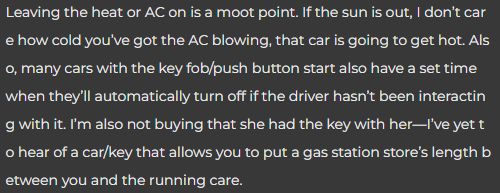
The largest cluster in this comment section is not interested in the marriage. Readers fixated on the unlocked car itself, treating it as a mechanical puzzle with a known failure rate. Story after story surfaced: car thieves who discovered infants in back seats and returned them, sometimes lecturing the parents before driving off again. The emotional register here runs closer to dark comedy than outrage. Readers catalogued these incidents with the connoisseur energy of people collecting variations on a theme, each anecdote functioning as proof that the wife’s habit was not a private parenting disagreement but a publicly documented category of disaster. The car thief who berated a mother and then stole the vehicle a second time became the thread’s unofficial mascot, a figure whose moral clarity readers found more reliable than the wife’s.
A second cluster responded with personal testimony, overwhelmingly from parents who had once made a similar mistake under sleep deprivation or routine disruption. These commenters drew a hard line between a single lapse and a sustained pattern. Their own near-misses gave them standing to condemn: precisely because they understood how easily it happens once, they could not comprehend choosing to let it happen repeatedly. The tone was confessional but firm, each story ending with some version of never again.
Climate and jurisdiction shaped a third group. Australian commenters in particular arrived with legislation, sentencing data, and firsthand accounts of children hospitalized after twenty minutes in a parked car. For this cluster the issue was never about the husband’s method. Danger was the only relevant variable, and they measured it in degrees Celsius and statutory penalties rather than in emotional fallout between spouses.
A smaller but persistent thread questioned whether CPS involvement in a secondhand anecdote from the comments was plausible as described. Foster parents and child welfare workers pushed back on the idea that a single behavioural pattern leads to permanent removal, suspecting missing context. Their skepticism applied the same investigative instinct to the comment section that the larger thread applied to the wife.
The comment section reveals a consistent pattern: readers processed this story by replacing the marriage conflict with a risk calculation. Almost no one engaged with the husband’s method as a relationship act. The staged disappearance registered as an engineering solution to a safety flaw, and the wife’s feelings about it barely entered the analysis. Empathy, when it appeared, attached to the hypothetical child in the hypothetical stolen car, never to the woman standing in the parking lot.
This editorial is based on a story originally shared on Reddit’s r/BestofRedditorUpdates community.