Featured on @StorylineReddit: November 15, 2025
The Spare Key He Handed Them
A Reddit false cheating accusation only works when the accused has already confessed to something real. OOP disclosed a past infidelity to Alice because he believed transparency was a form of respect. Her friend group received that same confession as raw material. They did not fabricate a lie from scratch. They engineered a staged kiss using the friend OOP trusted most as the delivery mechanism and his own history as the credibility engine. The conspiracy required his good faith to function.
What collapses here is not a relationship alone but a specific theory about how openness protects you. OOP operated under the assumption that disclosing a past mistake would inoculate the present against suspicion. Instead, it supplied the exact ammunition needed to destroy it. Alice’s friends understood something he did not: a confession, once shared, belongs to everyone who heard it. The person who volunteered it loses custody the moment the words leave.
Alice believed every person she grew up with over the one person she chose. That arithmetic looks different depending on which side of the phone call you occupied.
How a Reddit False Cheating Accusation Gets Built
The conspiracy had four load-bearing elements. OOP’s voluntary disclosure of past cheating supplied narrative plausibility. A man with no infidelity history kissing his girlfriend’s best friend strains belief. A man who once cheated and told his partner about it confirms a pattern people already expect.
Before the staged kiss, the friend group shifted from standoffish to physically affectionate. This calibration phase ensured OOP felt comfortable enough with Samantha’s proximity that a private meeting raised no alarm. He read manufactured warmth as genuine acceptance.
Samantha’s selection carried its own logic. She had positioned herself as OOP’s confidante during the earlier chill from the rest of the group. He had helped her process her own partner’s infidelity. That shared vulnerability made her the one friend whose invitation would trigger zero suspicion.
Then came corroboration. When Alice heard Samantha’s account, every remaining friend confirmed it. One accusation can be questioned. A full chorus among people she had trusted for twenty years created something closer to established fact.
The Aftermath as Architecture
OOP’s two-year shutdown followed its own rational design. The person he trusted with his worst secret weaponized it. The person he loved chose a phone call over a conversation. His nervous system ran the numbers on new connection and decided the margin was too thin.
Alice’s email landed in that fortified space and produced nothing. No skipped heartbeat, no anticipation. Meeting her in person began to dismantle the structure, not through grand gestures but through repeated proof that she would not exploit the access he gave her. The night she offered him an easy exit instead of pressuring intimacy served as the load test that carried the most weight.


The Confession That Loaded the Gun
OOP handed Alice his past cheating because he thought disclosure was a form of armor. The logic felt sound: if she knew the worst thing about him and stayed anyway, then nothing could blindside her. He treated his own history like a vaccination. Her friend group treated it like a blueprint.
Every functional false cheating accusation on Reddit requires a foundation the target built voluntarily. Samantha did not have to invent OOP’s capacity for infidelity. He had already confirmed it in his own words, in a conversation he initiated, during the early months of a relationship he valued enough to protect with honesty. The friends simply rerouted that honesty into a delivery system. They selected Samantha because OOP had already opened himself to her while helping her process her own partner’s betrayal. He had demonstrated trust. She catalogued it.
The staging was precise. Months of manufactured warmth from the previously standoffish group ensured that a private park hangout with Samantha triggered no alarm. OOP read the shift as acceptance. It was calibration.
The Group That Called It Protection
Friend groups that sabotage a member’s relationship rarely describe their motives as jealousy. The internal framing almost always runs through a vocabulary of concern. They worried about Alice. They saw her moving too fast. They had known her for twenty years and this man for barely one. The plan to move in together before the one-year mark gave them a deadline and a justification.
But concern does not require conspiracy. A friend who worries about the pace of a relationship raises the subject over coffee. A friend who organizes a coordinated kiss, pre-calls the girlfriend with a false version, and recruits the entire group as corroborating witnesses is running a different operation. The mechanism here borrowed the language of care while executing something closer to territorial enforcement. Alice advancing toward cohabitation threatened the group’s internal hierarchy. One commenter on identified it cleanly: people react badly when the friend they see as beneath them reaches a milestone first.
The Spare Key, Again
Samantha’s positioning deserves a second look through this lens. She was the one friend who stayed warm during the standoffish period. That warmth was not kindness. It was access maintenance. OOP confided in her about his worst moment, and she filed it where it would do the most structural damage later.
When the Fantasy Arrives and Finds Nobody Home
For a year after the breakup, OOP fantasized about exactly this scenario. Alice discovering the truth. The vindication. The reunion. When the email arrived, he felt nothing. No skipped heartbeat. No anticipation. His own language in the post carries the flat affect of someone reading a weather report about a city they used to live in.
That numbness was not dysfunction. It was the finished product of a two-year construction project. OOP built a structure designed to keep new information from reaching the parts of him that could be hurt. The structure worked. It worked so well that when the good news finally arrived, it hit the same wall as everything else. His best friend suggested this flatness might be preemptive self-protection. The simpler reading is that OOP’s nervous system had already closed the account.
Meeting Alice in person began to dismantle something the email could not reach. Seeing her face reintroduced a signal his body recognized even when his conscious mind did not. He describes the feeling as anticipation without knowing whether the outcome would be good or bad. That confusion itself was the breakthrough. Numbness does not wonder.
The Night She Offered Him the Exit
Alice deserved sharper scrutiny than OOP gave her. Choosing a phone-call breakup without hearing his version was not a reasonable concession to peer pressure. It was a failure of partnership that twenty years of friendship do not fully excuse. A partner who loves you and hears a devastating accusation still owes you a conversation. Alice skipped that step. The fact that her information was convincing does not erase the fact that she never tested it against his account.
Yet Alice’s behavior during the rebuilding phase carried its own weight. She did not push. She did not try to resume the relationship from its previous coordinates. She treated OOP’s caution as reasonable rather than insulting. The pivotal night came when she invited him upstairs and he hesitated. Instead of pressing, she offered him an easy exit about needing rest for work. That single gesture proved she would not exploit the access he gave her. OOP went upstairs. The sentence he wrote afterward is the quietest line in the entire post: “It’s not just two people together. It’s her and me together.”
How Readers Responded
The largest cluster arrived furious and stayed furious, but the anger had a specific shape. Commenters fixated on the collective nature of the conspiracy, not the kiss itself. A single treacherous friend registers as bad luck. An entire friend group operating in coordinated silence for two years registers as something closer to institutional failure. Readers returned again and again to the arithmetic of betrayal: not one, not two, but all of them. The emotional register ran hot, shading into disbelief that so many people could sustain a shared lie while watching its consequences unfold in real time across group hangouts and phone calls.
A second cluster positioned Alice as a co-victim rather than a bystander who chose wrong. One commenter’s framing of her as having been “hacked” gained traction because it recast her credulity as a structural vulnerability rather than a character flaw. These readers understood information cascades intuitively. Three separate sources telling the same story creates consensus in the brain, and Alice had far more than three. This group showed the most analytical register, citing social psychology concepts and drawing parallels to media manipulation. Their sympathy for Alice carried an implicit argument: punishing someone for trusting the people closest to them sets an impossible standard for any relationship.
The third cluster diagnosed the motive with surgical confidence. Reader after reader identified the trigger not as the relationship itself but as the couple’s plan to move in together. The friend group could tolerate Alice dating. Cohabitation crossed a different threshold, one that made the power disparity between Alice’s life trajectory and theirs impossible to ignore. Several commenters invoked the “crabs in a bucket” metaphor, and those who elaborated described a specific dynamic where the member perceived as lowest-status in a group faces retaliation for reaching a milestone first.
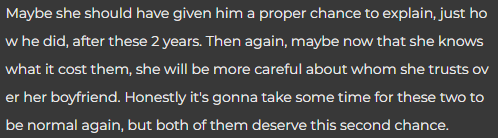
A fourth, quieter cluster complicated the happy ending. These readers noted the pyrrhic quality of the reunion and questioned whether the relationship could sustain the weight of what happened. Some pointed out that Alice will carry guilt indefinitely while OOP will carry the muscle memory of abandonment. The warmth in these comments was real, but it came laced with skepticism about whether starting over can ever fully displace what was lost.
The comment section’s most revealing feature is not the outrage but the volume of personal testimony it generated. Dozens of readers showed up with their own stories of friend-group conspiracies, coordinated exclusions, and reputations destroyed by collective fiction. This story functioned less as a narrative to judge and more as a mirror that caught light for people who had never found the right angle to examine their own scars. The friend group, not the couple, became the emotional center of the discussion, which says something pointed about where readers locate the real danger in stories about romantic betrayal.
This editorial is based on a story originally shared on Reddit’s r/BestofRedditorUpdates community.