Featured on @StorylineReddit: November 28, 2025
Reddit Family Favoritism Has a Soft Voice
Reddit family favoritism begins with two girls loving soccer, but only when their father is not sharing the game with the boys.
That detail matters because the daughters are not rejecting the park, sports, or their cousins. They get dressed in their kits, come home happy, and stay attached to the ritual when the afternoon is loose and playful. The shift happens when the twin nephews arrive and the mood hardens into a faster, more competitive version of the same outing. From the outside, everyone is still included. From the girls’ side, the part they love has already disappeared.
The mother sees that change before the father does because she is tracking anticipation and withdrawal. He is tracking generosity. Her argument begins with two children who stop wanting to go. His defense begins with two boys whose father is away for long stretches. Those are not equal forms of evidence, and that mismatch is why the conversation stalls.
Reddit family favoritism lands here as a quiet domestic accounting problem. Nobody is being shouted down. Nobody is being cast out. One set of children simply loses access to their father’s best version of attention while everybody can still claim the arrangement looks fair from a few steps back.
The Park Changes Before Anyone Says So
The important split in this story is not between daughters and nephews. It is between two versions of the same father. With his girls, soccer sounds almost improvised. They run around, play in a messy way, and enjoy him as much as the ball. With the boys there, he tries to keep that tone, but the nephews turn the outing into something sharper and faster. The daughters do not protest in the moment. They drift. That withdrawal is the real structural signal.
The Mother Hears the Silence First
Her request is easy to misread because it can sound like a territorial complaint about extended family. Yet the details cut the other way. She likes the boys, she acknowledges why they come over, and she keeps trying to recreate the same fun herself. The problem is not their presence by itself. The problem is that a shared activity starts serving the children who can dominate it, while the children who loved it first begin opting out.
That is why Reddit family favoritism feels accurate here, even if nobody intended favoritism. Preference does not always look like extra affection. Sometimes it looks like failing to protect the conditions under which one child can still participate with joy.
The update tightens everything. Once the older daughter quietly confirms that the cousins are the reason, the husband’s abstract defense loses its footing. He stops arguing from kindness toward his nephews and responds to the evidence sitting in his lap. The story becomes less about whether the mother phrased the concern perfectly and more about how quickly family dynamics change once the least forceful person in the room finally says yes.


The Girls Did Not Refuse Soccer
The daughters never stopped liking the activity. That is the first thing the story keeps proving. They still got excited, still dressed in their kits, still came back happy when the outing belonged to the familiar version of play they had with their father. Their complaint only surfaced when the twin nephews joined and the game sped up into something more competitive. One girl started saying she did not want to go. Then the younger one followed. Children usually do not draft position papers when a ritual stops feeling good. They just stop showing up for it.
That is why the mother’s read on the situation carries so much weight. She is not projecting a theory onto the afternoon. She is watching enthusiasm shrink in real time. The father keeps seeing a park trip. She keeps seeing two daughters lose the version of him they were coming for.
Inclusion Can Still Push Someone Out
Plenty of adults hide behind the idea of inclusion because it sounds morally clean. All four children are invited. Nobody is excluded. The outing still happens. From that distance, the arrangement looks generous and balanced. Up close, the balance is gone. The boys play faster, steal the ball, and tilt the energy toward themselves. The girls drift off and do their own thing halfway through. The father is present, but the part of him they wanted is tied up managing a different atmosphere.
That gap between access and experience is where family tensions get missed. A child can stand in the same park, on the same day, near the same adult, and still feel like the thing she loved has been handed over to someone else. Anyone reading can see that the mother is not arguing for ownership of her husband. She is arguing for preservation of a specific form of attention.
The Husband Heard Rejection Before He Heard Loss
His reaction is easy to understand and still wrong. He hears “set some kind of limit” and immediately thinks about two boys whose father is away in the army for long stretches. He imagines disappointment landing on children who have done nothing bad. He probably also hears an accusation against his own decency, because helping his sister and being a steady male presence to his nephews fits the image he has of himself. So he reaches for the language of cruelty.
But the boys are not the injured party in the version his wife is describing. The injury is already happening inside his own house, quietly, on Tuesdays, Sundays, and sometimes Fridays. His daughters do not fight for the game. They surrender it. That surrender looks mild from the outside, which is why it keeps getting underrated by the adult who is causing it without meaning to.
Reddit Family Favoritism Looks Polite
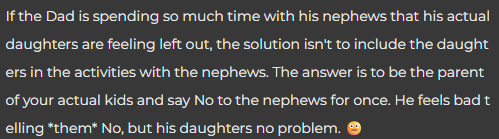
Reddit family favoritism in this case does not look like a father preferring his nephews over his daughters. That reading is too blunt for the facts on the page. He takes his girls to the park when the boys are not around. He put up a basketball hoop in the backyard. OOP says both daughters are daddy’s girls and that he dotes on them. The problem is narrower and more ordinary than open preference. He fails to protect the conditions under which his daughters can enjoy him.
That kind of failure is common because it hides inside good motives. He wants to be kind to children who miss their own father. He wants to keep the peace with his sister. He wants one outing to serve everybody. Yet shared arrangements often favor the children who impose themselves most easily. The boys do not need extra space to enjoy the game. The girls do. When he does not guard that difference, the outcome still tilts.
Her request was not cruelty. It was a belated attempt to stop a quiet leak in the house.
The Mother Could Name the Pattern, but the Daughter Had to Confirm It
The update changes the tone because the husband’s abstraction finally meets the right witness. His wife had already described the problem, but he could keep filtering her words through adult motives such as jealousy, fairness, and family obligation. Then his older daughter says no after being excited earlier that morning. She does not deliver a polished explanation. She avoids the reason, stays shy, and only admits it when he asks whether it is because of the cousins. That hesitation matters. Children often soften their own disappointment to protect the adults they love.
Once she says yes, he acts immediately. He does not text his sister. He tells the girls the boys cannot join right now and asks whether they still want to go. Suddenly both daughters are eager again. No theory could compete with that. The answer is sitting right there in their bodies, in the speed with which they go from reluctance to excitement, and in the fact that they run off to get dressed.
What Reddit Said
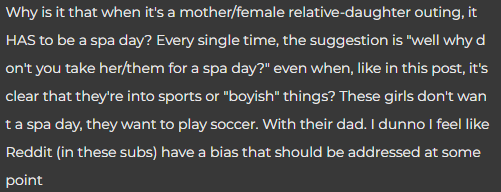
The largest cluster treated the thread as a familiar case of gendered misreading, not because the father openly preferred boys, but because so many commenters watched the discussion slide toward stereotypes the moment the girls’ disappointment had to be explained. The spa day suggestion became a lightning rod for that reason. Readers in this camp heard the daughters asking for roughhousing, movement, and playful attention from their dad, then watched other adults translate that into softer, more feminine substitutes. Their register was angry, with a sharp edge of recognition.
A second, nearly as large cluster focused less on sexism and more on scale, age, and play style. These commenters kept returning to the practical mismatch between six and eight year old girls and two nine year old boys who already treat soccer as a contest. Their logic was concrete. Older children move faster, hold space more aggressively, and can drain the fun from a casual game without intending to be cruel. That group sounded analytical, often pulling from rec leagues, gym classes, or childhood sports to explain why the girls’ retreat made perfect sense.
From there the thread widened into a third cluster built around paternal attention as a scarce resource. These readers were not especially interested in whether the nephews were sympathetic or whether the sister-in-law needed help. They read the story as a household jurisdiction problem. A father with limited free days kept giving the most emotionally satisfying version of himself to a group setting that his own daughters had already stopped enjoying. The recurring argument was that kindness toward extended family cannot come from the same pool every time. Their tone was compassionate, then increasingly frustrated.
Another visible cluster turned its attention toward the husband’s listening failure. Those commenters were less preoccupied with soccer than with the fact that his wife described the problem, got brushed aside, and only gained traction once a shy daughter confirmed it directly. That reaction drew in stories about husbands dismissing wives, fathers hearing girls only after a scene becomes undeniable, and women being treated as unreliable interpreters of their own children. The emotional register there was weary, sometimes grieving.
The comment section shows that readers process stories like this through their own archive of small humiliations. They do not wait for explicit cruelty when they recognize the shape of being sidelined, mistrusted, or told to accept a substitute. That is why the thread kept moving past verdict language and into memory. People were not only judging the husband. They were identifying the moment when a child learns that being included and being wanted are not the same thing.
This editorial is based on a story originally shared on Reddit’s r/BestofRedditorUpdates community.