Featured on @StorylineReddit: November 12, 2025
Spanish Was the Symptom
Everyone who read this Reddit nanny Spanish story assumed they were witnessing a racism confession, but the actual reveal had nothing to do with language at all. A husband tells the live-in nanny to speak only English around his four-year-old. His wife, blindsided, cycles through fury and lands on a single explanation: bigotry. Reddit agrees within hours. The diagnosis feels clean, satisfying, almost inevitable given the Southern California setting and the power dynamic between employer and caregiver.
Then the conversation happens, and the husband names something nobody predicted. He is drowning in career regret and paternal jealousy, watching his daughter bond with a woman who offers her something he cannot. The Spanish became a measuring stick for his own absence.
What nobody examined, including the wife herself, is how quickly she reached for the worst possible motive. Five years of marriage, no prior evidence of prejudice, and her first instinct was to convict rather than to ask. That reflex tells its own story about how well these two had been communicating long before the nanny became the flashpoint.
A Reddit Nanny Spanish Story That Diagnosed Itself Wrong
The post arrives pre-concluded. A wife has already classified her husband’s behavior as racism before asking him a single question about it. Hundreds of commenters reinforce the frame she chose. Not one prominent voice suggests she might be wrong, and no reply in the thread asks what else could explain a man suddenly policing his daughter’s language exposure.
Five days later, the actual conversation dismantles every assumption. Eric does not object to Spanish. He objects to the evidence of his own irrelevance. A daughter who speaks a language her father cannot understand is a daughter building a life he has no access to. His job, chosen for stability over passion, has become a cage that funds a household he barely inhabits. Ella’s competence and closeness with Katherine made the distance between provider and parent impossible to ignore. The Spanish was simply the first thing he could control.
The resolution is swift and cinematic. Apology, fancy restaurant, flowers, a card for the nanny and her grown daughter. Katherine keeps learning Spanish. Eric admits he wanted to be an actor, not an executive. His wife suggests he leave or take classes on the side. The emotional temperature drops from fury to warmth inside a single update.
Still unaddressed is the communication vacuum that allowed a man to erode professionally and emotionally while his partner noticed nothing for years. A crisis with the nanny forced the first honest conversation this couple appears to have had in a long time. The dinner was generous. Neither the dinner nor the flowers explained why it took a stranger’s hurt feelings to get two married people talking.


The Diagnosis Nobody Questioned
A four-year-old speaks Spanish in the backseat of a car. Within hours, her father has told the nanny to stop. Within days, hundreds of strangers on the internet have settled on a verdict: racism. The wife agrees. She writes that she “can’t see any other explanation,” despite five years of marriage producing zero prior evidence of prejudice.
That certainty is the first problem worth examining. Not because racism is an unreasonable suspicion, but because it became the only suspicion. The wife skipped triage entirely. She went from confusion to conviction without a single diagnostic question directed at her husband. Reddit filled the gap she left, and the consensus hardened before Eric ever opened his mouth.
When the actual conversation happened, the answer had nothing to do with ethnicity or language politics. Eric was jealous, exhausted, and professionally miserable. Every commenter who diagnosed bigotry had been confident and wrong.
The Job That Ate the Father
Eric wanted to act. Instead he became a media executive, and the trade hollowed him out so gradually that his wife had no idea he was suffering. Career regret alone does not explain asking a nanny to stop teaching Spanish. But career regret combined with parental guilt creates a specific kind of distortion: the impulse to shrink your child’s world so it fits inside the hours you have left.
Katherine was learning something valuable from someone who was present. Eric could not be present and could not offer the same thing. Rather than naming the helplessness, he tried to eliminate the evidence. Controlling Ella’s language was easier than admitting he had chosen a career that cost him his daughter’s afternoons. The request was not about Spanish. It was about reducing the visible gap between what Ella provided and what he could not.
Ella’s Competence and the Distance It Measured
Here the story shifts register. Ella apologized. She walked into the wife’s office, lowered her voice, and said sorry for teaching a child a second language. A 45-year-old professional caregiver, excellent at her job by every account, felt compelled to treat her own competence as an offense.
That moment deserves more weight than the resolution that followed it. Eric’s frustration was internal and eventually articulable. Ella’s position was structural. She depended on this household for her livelihood, and a single conversation with her employer made her feel she had overstepped by being too good at what she does. The power asymmetry between a live-in nanny and the family who employs her does not vanish because the wife is kind or because the husband later says sorry.
Katherine will keep learning Spanish. Ella will keep remembering which parent told her to stop.
Flowers for the Wrong Wound
The resolution reads like a screenplay treatment. Apology. Surprise dinner at the fancy restaurant. Flowers. A card. Ella’s adult daughter invited along. The gesture was generous and visually complete, and it addressed almost nothing structural about what happened.
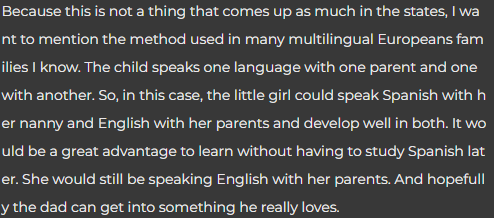
Eric’s request to preserve English as a shared household language was not monstrous. A father who fears linguistic exclusion from his own child is expressing a real anxiety, not performing bigotry. Calling it “really selfish,” as the wife did, compresses a legitimate parental fear into a character flaw and closes the conversation before it reaches the harder questions. Why did this couple go years without Eric admitting professional despair? Why was a nanny’s hurt the catalyst for the first honest exchange in their marriage?
The wife suggested acting classes. Eric remained unsure. The post ends with Katherine still learning Spanish, Ella still living in their home, and two married people who just discovered they had not been talking to each other for a very long time. The fancy restaurant was ‘s final image of repair. Ella’s quiet apology in the doorway of that home office told a different story.
How the Comment Section Diagnosed Itself
The largest cluster arrived with personal testimony. Dozens of commenters shared parallel stories of parents or grandparents who suppressed a heritage language, whether Spanish, French, Polish, Hungarian, German, or Korean. These responses carried a grieving register, and the grief was specific: not anger at the parent who made the choice, but mourning for the relationship with a grandparent that never fully formed because the words were never there. The sheer volume of these stories turned the comment section into an informal census of linguistic erasure across immigrant families in North America. Readers reached for this post not because of Eric’s jealousy but because it activated a loss they had already been carrying.
A second cluster, smaller but vocal, pushed back against labeling Eric’s behavior as emotional immaturity. These commenters were analytical rather than sympathetic, and their recurring argument centered on proportionality. Everyone acts selfishly under stress. Having a bad week and making a poor parenting call does not constitute a character deficiency. The sharpest version of this position pointed out that Eric had time to reflect before speaking to Ella, which made the decision deliberate rather than reactive. Both sides of this debate were arguing about the same question: whether a single bad decision reveals a pattern or an exception.
A third cluster focused on practical advice with an almost evangelical enthusiasm for childhood bilingualism. Medical professionals cited clinical advantages. Parents described immersion schools. Linguists explained neural pathways. The emotional register here was optimistic, bordering on urgent, and the underlying logic was forward-looking rather than diagnostic. These commenters had little interest in Eric’s motives. They wanted to make sure Katherine kept learning.
A fourth, wrier group treated the entire post as a class artifact. The live-in nanny, the screenwriter wife, the media executive husband, the surprise dinner at a fancy restaurant. Several commenters noted that the family’s financial comfort made the resolution available in ways it would not be for most households. One simply wrote that they were too poor for the thread.
The comment section performed exactly the diagnostic error the original post did. Readers sorted themselves by which version of the husband they recognized from their own lives, not by what the post actually described. The flood of heritage-language grief stories reveals how rarely people get to name that particular loss in public. Eric’s four-year-old stumbling through Spanish in a car seat gave thousands of adults a place to put a sadness they had been holding since childhood.
This editorial is based on a story originally shared on Reddit’s r/BestofRedditorUpdates community.