Featured on @StorylineReddit: November 14, 2025
A Bin Bag Is Not a Favour
Most people reading this Reddit Pokémon collection divorce story will fixate on the monetary value of the cards, but the price tag was never the point. OOP said so himself: he would never have sold them. The binders on that office shelf were not an investment portfolio. They were evidence that a thirty-year-old man still had access to the version of himself who existed before mortgages and marriage.
His wife did not throw away cardboard. She threw away the part of his identity she found inconvenient, then expected gratitude for the surgery. “You should thank me for helping you move on” is not the language of someone who made a mistake. That sentence belongs to someone who believed she held editorial authority over which pieces of her husband were acceptable to keep.
The speed of his response tells us he understood the difference immediately. This Reddit Pokémon collection divorce was decided before the comment section even finished sharpening its pitchforks, because OOP did not need strangers to explain what had just happened to his marriage.
A Divorce Written in Pokémon Cards
The architecture of this story runs on a single pivot: the wife’s confidence that her husband would comply. When she mentioned the disposal “casually,” she was not confessing. She was announcing a completed renovation, expecting him to admire the new floor plan. That casualness is the most revealing detail in the entire post. People who feel guilty do not deliver news over their shoulder.
Her doubling down confirms the read. Telling a grieving partner to say thank you is not defensiveness. It is a power assertion wrapped in parental language: I know what you need better than you do, and you will agree once you grow up. Only after OOP moved out and stated his intent to file did the framing shift. Suddenly “you should thank me” became “a lapse in judgement,” a phrase that miniaturises a deliberate, premeditated act into an accidental stumble.
OOP’s trajectory runs in the opposite direction. Where his wife kept revising her story downward, he stayed fixed. His original post already contained the conclusion: “she has saved me many more years wasted with her.” No bargaining phase. No Reddit-fuelled revenge arc. He declined financial restitution and donations alike, redirecting generosity toward a homeless shelter. Whether this composure reflects genuine clarity or a man who had already been cataloguing quiet reasons to leave, the result landed the same way.
The comment section wanted a villain origin story. OOP gave them a clean break and a forwarding address for charity.


The Gift Nobody Asked For
“You should thank me for helping you move on.” Strip that sentence down and the grammar tells you everything. The subject is “you.” The verb is “thank.” The beneficiary is “me.” A woman who destroyed her husband’s property without permission constructed a sentence in which he owed her for the act. This is not carelessness. Disposal framed as improvement requires a prior belief that the other person’s attachment is a defect you are qualified to correct.
She did not hide what she had done. She mentioned it casually, the way someone mentions taking out actual rubbish. That delivery method was a test, whether she knew it or not. Had OOP shrugged and moved on, the precedent would have calcified: her judgment about which parts of his life deserved to exist would have become the operating standard of the household.
When “Grow Up” Means “Comply”
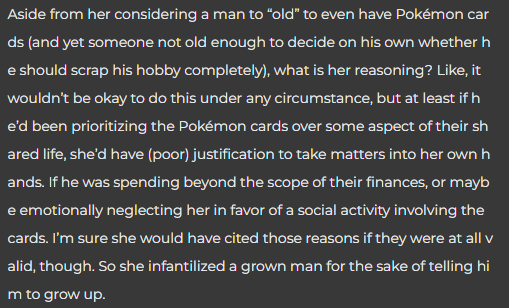
The justification she chose is worth examining for its precision. “You’re a grown man, you don’t need to play with kids stuff.” She did not say the cards were ugly, or taking up space, or gathering dust. She reached for a social script about masculinity and maturity, one designed to make any pushback sound like proof of the original accusation. Defend the cards and you confirm you are childish. Accept the loss and you confirm she was right to intervene.
This Reddit Pokémon collection divorce gained traction online partly because the trap is so legible from the outside. Gendered shame about hobbies works best in private, where there is no audience to name the mechanism. OOP’s decision to post, even framed as venting, broke that containment. Thousands of strangers immediately identified what the wife had counted on him absorbing alone.
The Man Who Did Not Bargain
Here the story turns quieter and harder to read with confidence. OOP moved out within days. He declined donations. He refused to pursue the cards through waste services beyond a single check. He told a commenter he would grieve the Pokémon cards longer than the marriage.
That sentence deserves a slower read than the comment section gave it. A man who grieves objects longer than a two-year marriage is either performing detachment for an audience, or he is describing a relationship that had already been losing weight for some time before the cards disappeared. His composure does not read like shock processed at unusual speed. It reads like confirmation.
OOP’s refusal to pursue financial restitution or even attempt a conversation is not strength. It is avoidance wearing the costume of decisiveness, and it forecloses any possibility that the marriage contained something worth examining before he discarded it as quickly as she discarded the binders. The comment section celebrated his clarity. Clarity that arrives without friction is sometimes just a decision that was already made, waiting for permission.
“A Lapse in Judgement”
Between the original post and the update, the wife’s language underwent a full renovation. “You should thank me” became “it was a lapse in judgement.” The first version claimed authority. The second claimed accident. Both cannot be true, and the shift only appeared after OOP moved out and stated his intention to file.
This is damage control operating on the smallest possible budget. “Lapse” implies a momentary failure in an otherwise sound system. But she bought bin bags, collected multiple binders from a shelf, and carried them out of the house without mentioning it for a week. That sequence does not lapse. It plans, executes, and waits.
In , OOP noted one final detail about this Reddit Pokémon collection divorce: she threw the cards away the previous week and only acknowledged it when asked directly. She lived comfortably with the empty shelf for seven days, expecting he would too.
What the Comment Section Built
The largest cluster treated the disposal not as a marital spat but as a diagnostic event. Commenters like HestiaIsBestia6 and CaptDeliciousPants framed destroying a partner’s possessions as the opening move in an escalation pattern, drawing on abuse literature and personal experience. The emotional register ran analytical rather than angry. Readers in this group were less interested in the Pokémon cards than in the grammar of control they recognised: target something the victim loves, frame the destruction as a favour, wait for compliance. Several cited the “Why Does He Do That” principle that selective destruction is never accidental. One commenter recalled choosing unbreakable gifts for a mother whose husband smashed her belongings. These responses carried the weight of recognition, not speculation.
A second cluster fixated on the maturity script the wife deployed. The phrase “you’re a grown man” activated a nerve that ran well beyond this particular marriage. Readers swapped stories about partners, parents, and colleagues who weaponised the word “adult” to police hobbies. The C.S. Lewis passage on putting away childish things appeared twice, quoted in full both times, functioning as a shared rebuttal readers had been carrying in their pockets for years. The emotional register here was defiant. These commenters were not defending OOP so much as defending the principle that joy does not require justification.
A smaller but persistent thread questioned the wife’s stated motive. Multiple readers refused to believe the cards were simply binned, pointing to their potential five-figure value. Others speculated that outside influence, possibly family members with rigid ideas about masculinity, had pushed the wife toward action. This cluster operated in detective mode, treating the wife’s explanation as a cover story too thin to hold weight. Their scepticism revealed less about the wife and more about how readers process stories where the stated reason feels disproportionate to the act.
A fourth group arrived bearing parallel stories. Burned letters from a deceased mother. Comic collections lost to floods and negligent spouses. MTG cards thrown out and litigated in court. Each anecdote served the same structural purpose: proof that this was not an isolated event but a recurring pattern in which one partner claims jurisdiction over another’s interior life.
The comment section processed this story almost entirely through pattern recognition rather than emotional reaction. Readers reached for frameworks, cited literature, and offered case studies. The wife became less a villain than a specimen, examined not for her cruelty but for how neatly she fit a template that thousands of people had already survived and catalogued.
This editorial is based on a story originally shared on Reddit’s r/BestofRedditorUpdates community.