Featured on @StorylineReddit: November 10, 2025
She Still Thinks It’s Funny
She laughed before she even finished saying his name, and that reflex told the entire Reddit girlfriend bullying disabled classmate story before a single detail could. Three months of chemistry dissolved in a single evening, not because of what she described, but because of the grin she wore while describing it. The laughter was a second confession layered beneath the first. A woman recounting coordinated cruelty toward a cognitively disabled classmate showed zero distance between her younger self and her present one. No wincing. No qualifier. Just the bright energy of someone replaying a highlight reel.
OOP’s instinct told him something was wrong immediately. He spent days trying to talk himself out of that instinct. The real tension in this post is not whether the girlfriend is cruel. Her own words settled that question before he could even ask it. The tension is how close OOP came to burying what he knew because the relationship felt good, and how many people in his position never bring it back up.
Reddit Girlfriend Bullying Disabled Classmate as Punchline
OOP posted to r/relationship_advice framing his situation as a possible overreaction. That framing itself reveals the problem. A man who just heard his girlfriend describe years of orchestrated cruelty toward a cognitively impaired teenager still wondered whether his discomfort was the unreasonable part. Chemistry had done its work. Three months of feeling understood made him willing to question his own moral clarity rather than hers.
Her stories arrived voluntarily, without prompting and without shame. She offered them as entertainment, the same way she had once offered a fake relationship to a boy who could not decode the joke. The consistency matters. Between the telling and the original acts, nothing had shifted except the audience.
“He Was Just There to Make People Laugh”
When OOP raised the subject a second time, she laughed again before answering. Pressed for a reason, she produced a sentence that collapsed any remaining ambiguity: “he had no purpose, he was just there to make people laugh.” This was not a teenager’s cruelty filtered through adult embarrassment. This was a current assessment, delivered with the casual confidence of someone who had never been challenged on it.
OOP’s confrontation drew first disbelief, then fury. She accused him of abuse for naming what she had done. A woman who once stripped a disabled boy of his pants in a public park and drove away called the man who objected to it an abuser. The reversal was instant and total. OOP saved her angry follow-up texts, and that instinct suggests he already understood what her final performance confirmed.


The Architecture of Recreational Cruelty
The bullying was not impulsive. It was engineered across multiple episodes with distinct roles, rehearsed setups, and a target selected precisely because he could not defend himself. She pretended romantic interest. Her friends waited nearby. The boy removed his pants in a park because a girl he trusted asked him to. Then everyone drove away.
Each cycle required planning: who would lure, who would watch, who would take the evidence. The victim’s cognitive disability made him ideal not despite his vulnerability but because of it. He kept returning to her after every humiliation because he could not process that the person offering affection was the same person orchestrating his degradation. She exploited a specific neurological limitation as a renewable resource for entertainment.
This was not peer conflict. Peer conflict requires two people who can read the game. She built a system that depended on one person never understanding the rules.
“He Had No Purpose”
When OOP asked why they targeted him, she offered a seven-word moral framework: “he had no purpose, he was just there to make people laugh.” The sentence does not describe a past belief. She delivered it at twenty-two with the same ease she would have used at sixteen. No past tense. No softening particle. A current-tense classification of a human being as raw material.
The phrase “no purpose” is the load-bearing word. It does not mean she found him annoying or strange. It means she assigned him a function and saw that function as self-evident. People who categorize others this way do not restrict the framework to one target. The category expands to include anyone who cannot retaliate: children, subordinates, animals.
The Dog Knew First
A commenter in this Reddit girlfriend bullying disabled classmate thread predicted she probably teased dogs by holding food above their heads. OOP confirmed it. She had done exactly that the first time she ate near his dog, stopping only when told to.
The prediction worked because cruelty toward the powerless follows a behavioral signature. The specific target changes. The mechanism stays fixed: identify a creature that wants something, dangle it, enjoy the confusion. A cognitively disabled teenager reaching for a relationship he could not have. A dog reaching for food held just out of range. Both scenes share the same geometry. Both require a person who finds the gap between desire and comprehension amusing rather than painful.
OOP dismissed the dog incident when it happened. Most people would. Isolated, it looks minor. Placed beside the high school stories, it forms a pattern that crosses species and context.
Incredulity, Then Rage
OOP told her what she had done was horrific. Her first response was bewilderment. She searched his face for the punchline. Her second response was fury. She accused him of “shaming” her, reframing his moral objection as abuse. Within minutes, she told him she never liked him anyway and called him a loser.
The sequence matters. Disbelief came first because she had genuinely never encountered someone who found her stories repulsive. Every audience before OOP had laughed, or at least stayed quiet. Moral objection registered as foreign input, so unfamiliar she assumed it must be a joke. When she realized it was sincere, she did not reconsider. She attacked.
Calling OOP an abuser for naming her cruelty inverted the entire moral structure of the conversation. The woman who helped strip a disabled boy in a park and left him to walk home in his underwear positioned herself as the victim of the man who said that was wrong. That inversion was not calculated strategy. It was reflex, the automatic response of someone whose cruelty has never carried a cost.
The Gravity of a Good Evening
OOP nearly did not confront her. He describes their last evening together as genuinely great, and he admits he wanted to let the whole thing go. That admission is the most honest sentence in either post. Three months of chemistry created enough gravitational pull to make a man consider living with what he knew. In this Reddit girlfriend bullying disabled person dilemma, the danger was never the girlfriend alone. It was the willingness to trade moral clarity for comfort.
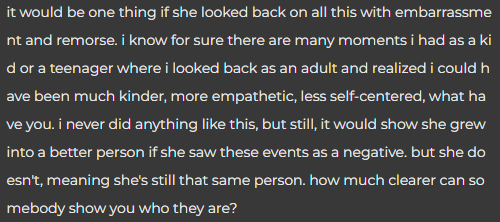
Her lack of remorse may not indicate sociopathy. It may reflect something less dramatic and far more common: arrested moral development. No one in her social circle ever told her the behavior was wrong. Her friends participated. Her adult life apparently never produced a confrontation. OOP may have been the first person to name her cruelty out loud, and her shock supports that reading.
But arrested development and fixed cruelty produce identical behavior in the absence of external pressure. Whether she cannot feel remorse or simply was never asked to makes no practical difference to the people in her path. OOP recognized that and chose to leave anyway. His choice did not hinge on diagnosing her. It hinged on what he could tolerate knowing.
He saved her angry morning texts, and that quiet act of self-protection tells you he already understood what kind of person stores well when the room is friendly and turns corrosive the moment someone says no.
The Audience Already Knew
The largest cluster fixated on the girlfriend’s accusation that OOP was “shaming” her. Readers recognized the inversion instantly: a woman who orchestrated years of humiliation against a disabled teenager recast a single moral objection as abuse against herself. Commenters did not treat this as hypocrisy. They treated it as diagnostic. The consensus held that her inability to distinguish between being held accountable and being attacked confirmed she had never processed consequences for cruelty. Several readers connected this to broader patterns they had witnessed in workplaces and families, where the person who inflicts harm consistently becomes the loudest victim when confronted.
A second cluster gathered around the girlfriend’s statement that the boy existed only to make people laugh. Readers responded to this line with a visceral chill that cut through the usual Reddit commentary tone. They did not analyze it so much as recoil from it, treating the sentence as a window into a moral framework where human value is assigned by the powerful and revoked without appeal. One commenter called it the most disturbing sentence they had ever read on the platform. The emotional register here was not anger but something closer to dread.
The third cluster comprised readers who confessed to their own bullying pasts. These commenters described childhood cruelty they participated in and the shame that followed them into adulthood. Their function in the thread was contrastive. By demonstrating what remorse looks like, they sharpened the absence of it in the girlfriend. The emotional register was raw and self-critical, and readers used their own guilt as evidence that moral growth requires confrontation with past behavior.
A smaller but persistent group focused on the dog. Readers treated OOP’s confirmation of the food-teasing prediction as proof that cruelty toward the powerless operates as a stable trait across contexts. The dog was not a metaphor for them. It was data.
What the Thread Performed
The comment section functioned less as advice and more as collective moral processing. Readers needed to place the girlfriend into a category that explained her behavior without requiring them to believe such people are common. The word “sociopath” appeared repeatedly, not as clinical diagnosis but as a container for a discomfort most commenters could not otherwise articulate: that someone can be charming at dinner and hollow underneath, and that the only reliable test is how they treat those who cannot fight back.
This editorial is based on a story originally shared on Reddit’s r/BestofRedditorUpdates community.