Featured on @StorylineReddit: November 9, 2025
A Conversion That Bought Nothing
A man converted to Catholicism for his wife’s family, and six years later they still treated him as a placeholder. That fact alone makes this Reddit in-laws baby name dispute less about what to call the child and more about whether the father was ever supposed to stay.
OOP spent six years performing belonging. He changed his religion and tolerated racial remarks about his Middle Eastern heritage. He absorbed backhanded comparisons to a cheating ex the family still preferred. None of it registered. When the couple shared potential baby names, the in-laws dismissed them as “foreign nonsense,” and the performance finally met its real audience.
Then the deeper disclosure arrived. OOP’s wife confronted her mother, who admitted the family had assumed OOP was gay since high school because he sewed and did theatre. They had spent years waiting for him to leave on his own. The naming fight was never about Italian heritage. It was a territorial claim by people who believed the territory would soon be vacated.
Six Years of Auditions, No Callbacks
The story operates on two levels that only converge at the end. On the surface, a couple expecting their first child faces pushback from the wife’s Italian-American family over baby names. Beneath that, a husband discovers that every concession he made over six years fed a ledger he was never going to clear.
OOP’s conversion from Orthodox Christianity to Catholicism registered as compliance, not commitment, in the eyes of a family that had already picked a different groom. They critiqued his ethnicity and his politics. They measured his Victorian fixer-upper against a new-construction house belonging to the family friend they still preferred, a man whose main qualification was being Italian and whose main flaw was cheating on their daughter. Each offering OOP made bought tolerance but shifted nothing. The distinction only sharpened once there was a child to name.
A Reddit In-Laws Baby Name Fight That Cracked Something Older
The real pivot arrives when OOP’s wife calls her mother and pulls out an admission concealed for years: the family assumed OOP was gay. His hobbies and quieter demeanor became, in their reading, proof that he was temporary. The naming conflict forced a confrontation they kept deferring because they expected the marriage itself to dissolve without their help.
OOP’s wife hung up with a boundary that was blunt and overdue: no contact until the family could respect both partners. The story remains ongoing, but the structural shift has already landed. This couple moved from a dynamic where one partner auditioned for the other’s family to one where both decided the audition was finished.


The Toll Booth That Never Opens
OOP converted from Orthodox Christianity to Catholicism. He did not do it under duress, having wanted to convert since age seventeen, but the timing and the audience mattered. His wife’s family watched him change religions, and it bought him nothing. Not warmth. Not trust. Not even the benefit of the doubt when he picked out baby names.
Converting faith traditions is not a small act. It cost OOP friction with his own relatives. He describes going through “a lot of grief” after announcing the change. So the currency was real, drawn from a finite account of familial goodwill on his own side. Yet on the receiving end, the deposit never cleared. His in-laws pocketed the conversion and kept the ledger open, adding new debts: wrong ethnicity, wrong politics, wrong house, wrong number of children. Each concession confirmed their leverage without reducing the balance owed.
When Compliance Becomes the Problem
A pattern like this trains both parties. OOP learned that effort would be met with new criteria. The in-laws learned that criteria would be met with new effort. Neither side had any reason to stop the cycle until something forced a ceiling. The baby did that.
The Understudy Who Was Supposed to Leave
The family friend haunts this story without appearing in it. He cheated on OOP’s wife in high school. He remains single. The in-laws still prefer him. When OOP and his wife gave a tour of their first home, the in-laws compared it unfavorably to the family friend’s new-construction house in a cheaper state. They measured a Victorian against a tract home and declared the tract home superior, because the point was never about square footage.
Preferring a cheater over a faithful husband requires a value system where loyalty ranks below tribal membership. The in-laws told their daughter as much when she raised the infidelity: “It was only high school, I’m sure he’s matured now.” Faithfulness was a phase the family friend would outgrow. OOP’s foreignness was permanent. That hierarchy clarifies every complaint they ever lodged. The house was too small because the wrong man owned it. The baby names were foreign because the wrong man chose them.
Sewing Machines and Stacked Disqualifications
Here the story pivots from frustrating to something harder to sit across from. OOP’s in-laws assumed he was gay because he sewed and participated in theatre. They carried that assumption silently for years, expecting the marriage to collapse on its own. The homophobia layered on top of the racism and the political contempt, creating a composite rejection that no single gesture of goodwill could have dismantled.
OOP’s six years of accommodation did not just fail to change minds. They actively reinforced the idea that his identity was negotiable. A man who converts his religion and absorbs racial comments without walking away looks, to people already inclined to dismiss him, like someone who agrees his original self was insufficient. Every adaptation signaled that the next demand would also be met. When the in-laws insisted on Italian baby names for a third-generation American family that likely cannot locate Calabria on a map, they were following a logic OOP had spent six years validating.
That is not a comfortable reading of events, and OOP does not deserve blame for his in-laws’ prejudice. But the dynamic between appeasement and entitlement ran in one direction for so long that the naming dispute was its inevitable product.
When the Reddit In-Laws Baby Name Fight Became a Referendum
The baby names were “foreign nonsense.” The phrase did heavy lifting. It collapsed every prior grievance into a single demand: this child will carry our cultural markers, not yours. For a family that had already rejected OOP’s ethnicity, religion of origin, political identity, and perceived sexuality, naming rights represented the last available claim on a daughter they felt was slipping away.
OOP’s wife ended the call with a sentence that carried six years of deferred weight: “Until you can learn to respect me AND my husband, don’t expect me to talk to you.” The boundary landed. Whether it holds is another question, and remains marked ongoing. But the couple is now considering OOP’s late grandfather’s name, misspelled during immigration into something with a feminine ending, a detail that carries its own quiet history of identity reshaped by forces beyond one family’s preferences.
What the Thread Actually Argued About
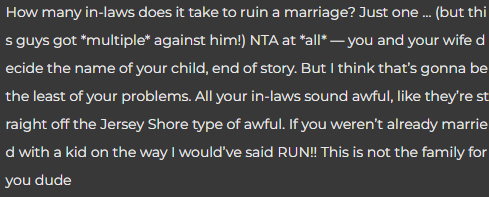
The largest cluster barely engaged with the baby name dispute. Instead, readers zeroed in on the in-laws’ third-generation Italian-American identity and dismantled it with the precision of people who had been waiting for exactly this target. Actual Italians from Italy weighed in to disclaim any connection. Commenters with similar family backgrounds shared parallel stories of heritage treated as a loyalty oath rather than a lived experience. The emotional register was less angry than amused, a collective eye-roll from people who recognized cultural performance detached from cultural knowledge. One commenter’s observation that the in-laws probably cannot locate Italy on a map became a refrain, not because it was clever, but because it named the absurdity that made the naming demand so hollow.
A second cluster projected forward to the unborn child and landed on a bleaker frequency. Several readers, some drawing from biracial family experience, predicted that grandchildren who physically resemble OOP will receive less affection than those who favor the wife. This group processed the story not as a conflict with a resolution but as a pattern with a trajectory. Their concern was not whether boundaries would hold but whether proximity to these grandparents would produce a new generation of damage. The tone here was knowing rather than speculative.
A third group turned the thread into a broader referendum on immigration hypocrisy, swapping personal anecdotes about immigrant families who despise newer immigrants. The stories piled up from multiple countries and contexts, each reinforcing the same mechanism: belonging becomes a gate you close behind you. This cluster treated OOP’s in-laws as a specimen of a recognizable type rather than as individual antagonists.
The smallest but sharpest cluster focused on the wife’s decision to hang up and cut contact. These commenters read the story as a partnership narrative rather than a prejudice narrative, praising her boundary-setting while noting that OOP’s instinct to keep accommodating had been part of the problem. A few pointed out that his willingness to defer to her parents on naming rights, even briefly, showed how deeply the appeasement pattern had settled.
The comment section split along a revealing line. Readers who focused on the in-laws’ identity performance treated the story as comedy. Readers who focused on the unborn child treated it as a warning. Both groups were right, and the distance between their readings measured exactly how much this family still has to negotiate before the baby arrives.
This editorial is based on a story originally shared on Reddit’s r/BestofRedditorUpdates community.