Featured on @StorylineReddit: November 9, 2025
The Man Who Quit His Own Birthday
In this Reddit birthday cake MIL conflict, the most revealing detail is not who took the cake but who stopped asking for one. A husband watches his mother-in-law walk out the door with half of his six-inch Parisian chocolate cake, meant for a nephew he has never been asked to prioritize before. He objects once, mildly. His wife tells him the objection itself was the offense. By the update, he has canceled birthday cakes altogether and framed surrender as simplicity.
The story arrives dressed as a small disagreement about leftover dessert. It leaves as a portrait of a man who has learned that expressing a preference inside his own marriage triggers a correction. His wife does not mediate between him and her mother. She assigns fault, invoking culture as a closed door rather than an open conversation. OOP’s final decision to replace the tradition with a café slice is not a compromise. It is the quiet arithmetic of someone who has calculated that wanting things costs more than going without.
A Birthday Cake Nobody Was Allowed to Keep
The geography of this conflict matters. A six-inch cake in a household where MIL was originally supposed to spend the night. The sister-in-law’s last-minute need for help rerouted MIL’s evening, and with her went the remaining cake, seized without consultation. OOP voiced one objection: he wanted the leftover for tomorrow. MIL reframed it on the spot, accusing him of taking food from a five-year-old. His wife, informed after the fact, told him his mild pushback required an apology.
Two people corrected him for the same moment, and neither correction addressed what he actually said. MIL made it about generosity toward a child. His wife made it about culture. Both framings share a function: they relocate the conversation away from whether OOP’s preference registers at all. The Reddit birthday cake MIL dynamic here is less about dessert etiquette and more about who holds veto power over the smallest domestic decisions.
The update strips any pretense of resolution. OOP does not negotiate a system for next time or ask his wife to mediate differently. He eliminates the occasion. No more birthday cakes. They will visit a café, share a single slice, and sidestep the risk of him wanting something that someone else decides to redistribute. Comment sections caught this as sadness. Few caught it as a pattern. A man who spent years earning provisional acceptance from his in-laws has learned exactly how much room his own wishes occupy in the household: none, unless pre-approved.


Six Inches of Chocolate and a Whole Family Pecking Order
A Parisian chocolate cake from his favorite bakery. Six inches. Half remaining. These are small numbers, and they map a precise hierarchy. MIL did not ask whether she could take the leftover. She picked up the box and walked toward the door. OOP asked a question. She responded with an accusation: he was stealing dessert from a five-year-old nephew. The cake moved through this household the way authority does. Downward from MIL, laterally to the sister-in-law’s family, and never back toward the man whose birthday occasioned it.
The five-year-old is a useful prop in this sequence. No one planned to bring him cake until MIL improvised the gesture on her way out. The child had not been promised anything. Yet within seconds of OOP’s mild objection, the nephew became the moral centerpiece, and OOP became the adult who would deny a small boy a slice of chocolate. That reframing happened fast enough to suggest it was not improvised at all.
The Word “Cultural” Does the Heavy Lifting
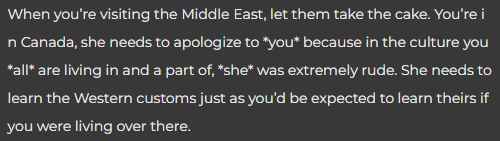
OOP’s wife told him he owed MIL an apology because sharing food is a cultural expectation. That explanation does two things simultaneously. It provides a reason, and it removes his right to question the reason. Culture, invoked this way, functions as a closed jurisdiction. OOP cannot evaluate the claim independently. He does not speak his wife’s language. He has no direct access to the norms being cited. His wife holds the interpretive monopoly on what counts as rude in their household, and she has ruled against him.
Several commenters from Middle Eastern backgrounds pushed back, calling MIL’s behavior rude by any standard. One commenter with Saudi cultural knowledge called it a power move, not a tradition. OOP himself noted the gap: “I understand cultural differences but I don’t appreciate being manipulated using ‘cultural thing.'” He could see the mechanism clearly. Seeing it changed nothing. His wife had already decided that his discomfort was the problem, not its cause. In the Reddit birthday cake MIL exchange on , the community spotted this asymmetry almost immediately.
Still, the wife’s position holds a sliver of defensible ground. If MIL’s household norms genuinely treat food as communal property once served, then OOP’s public hesitation forced a loss of face that his private complaint to his wife could not undo. Hospitality cultures do not always distinguish between “I’d prefer to keep this” and “I am refusing generosity.” His wife may not have been manipulating him. She may have been translating a genuine collision between two systems where graciousness means opposite things.
A Café Slice Instead of a Cake
The update is where the story turns cold. OOP does not ask for a different arrangement. He does not propose hiding a second cake or celebrating when MIL is absent. He removes the tradition. No more birthday cakes. A café visit, a shared slice, no leftovers for anyone to redistribute.
He frames this as drama reduction. The tone suggests something flatter. A man who fought for years to gain provisional acceptance from his in-laws has absorbed a specific lesson: wanting something in this household invites correction. The safest position is to want less. His wife bought him that six-inch cake from his favorite bakery, a gesture of knowing him well. One evening later, she told him his attachment to it was the problem. The next sentence he wrote was about giving up the tradition entirely. Between those two moments sits a quiet, practiced surrender that no slice of Parisian chocolate at a café will replace.
Where the Frosting Hit the Fan
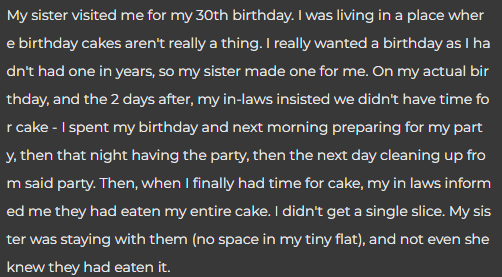
The largest cluster treated the incident as a property rights case. Birthday cake belongs to the birthday person. Full stop. These commenters did not engage with cultural nuance or family dynamics. They operated from a clean jurisdictional principle: you do not take food from someone’s home without being offered it. The emotional register ran hot, with several readers describing their own cake traditions in possessive, gleeful detail. One recounted a father who felt so guilty about eating the last slice that he drove back to the bakery the next day. The enthusiasm was less about OOP specifically and more about defending a ritual these readers clearly hold sacred.
A second, equally vocal group zeroed in on the wife’s role as failed translator. Cross-cultural marriages require someone to stand in the gap, and OOP’s wife chose her mother’s side without hesitation. Commenters from immigrant families recognized the pattern: one partner weaponizes cultural norms selectively, invoking tradition when it serves the family of origin and ignoring it otherwise. Several pointed out that the wife could have warned OOP in advance or bought a larger cake. Her failure to do either suggested she already knew how the evening would end and chose not to intervene.
A smaller but sharper cluster pushed back on the cultural framing altogether. Multiple readers from Middle Eastern and Eastern European backgrounds rejected MIL’s behavior as representative of any hospitality tradition. One commenter outlined the unspoken rule in their own culture: you never take the last portion, and leftovers are offered by the host, never seized by the guest. These responses carried an analytical frustration, directed less at MIL and more at the idea that rudeness could borrow legitimacy from geography.
A fourth group noticed the update before anyone explained why it mattered. OOP’s decision to cancel birthday cakes entirely struck these readers as passive-aggressive capitulation. Some called it dramatic. Others recognized it as the move of someone who has run out of negotiating room. The divide within this cluster tracked a single question: was OOP setting a boundary or performing his own defeat?
The comment section processed this story almost entirely through analogy. Readers reached for their own birthday cakes, their own in-laws, their own moments of swallowed protest. That reflex reveals how small domestic thefts function in collective memory. Nobody forgets who took their cake. The specificity of the loss is precisely what makes it stick, and precisely why thousands of strangers volunteered their own versions without being asked.
This editorial is based on a story originally shared on Reddit’s r/BestofRedditorUpdates community.