Featured on @StorylineReddit: November 5, 2025
Groceries Twice a Year and a Lifetime of Debt
This Reddit half-sister caregiver guilt story opens on a contradiction sharp enough to cut: the man who abandoned one family now demands that family’s daughter serve the one he chose instead. Sophie’s father cheated throughout her mother’s marriage, left to raise his firstborn with the other woman, and spent two decades treating Sophie as a margin note. She never had her own room at his house. His financial contribution to her life amounted to grocery runs, twice a year.
Then Claudette called. Not to reconnect. To ask Sophie to become Ariel’s live-in caregiver at college. The pitch arrived dressed in the language of blessing and sacrifice, as though biannual groceries build a debt large enough to collect on for life. Ariel’s disability is real, and her need for support is real. But Claudette and Sophie’s father never built infrastructure for that independence. They let Ariel stagnate for years and removed every obstacle to her comfort. When the bill arrived, they turned to the expendable daughter.
Reddit Half-Sister Caregiver Guilt as Family Accounting
Sophie exists in her father’s household the way a fire extinguisher exists behind glass: ignored entirely until an emergency, then expected to perform on command. Claudette’s phone call did not arrive as a question. It arrived as an invoice. The presumption that Sophie should surrender her dorm room and her autonomy for a half-sister she barely knows rests on a ledger only one side ever kept.
Every argument Ariel deployed in her follow-up call reinforces the transactional logic. “Your mom is really helping you out, so you should extend the same hand to me” treats one parent’s love as currency that should transfer across family lines. “We shared a room before” references the bunk beds in Ariel’s room, the room that was always Ariel’s, where Sophie slept as a guest in her own father’s house. Even the appeal to closeness rings hollow. Ariel once called Sophie’s mother a “useless bitch” for helping Sophie buy a car Ariel could not drive.
The Email and the Exit
Sophie’s response carried the controlled temperature of someone who had already grieved this relationship. “Best wishes, Sophie.” That sign-off, addressed to her own father and stepmother, reads less like a boundary and more like a eulogy. Her father’s reply confirmed the long game: “What happens when we die? Will you just leave Ariel and Sebastian all alone?” The question accidentally exposed the architecture. Sophie was never a daughter in this household. She was a retirement plan.
Sebastian’s absence from the entire exchange deserves attention. Claudette’s own son moved several states away. He built a system where he calls Sophie on his terms. The person who grew up inside this family reached the same conclusion as the person who grew up outside it. Both left.


The Daughter Who Appeared on the Balance Sheet
Sophie’s father bought her groceries twice a year. She mentions this detail without self-pity, almost as an accounting correction. Claudette had told her she “had a lot of blessings in her life” and that it was “time to give back.” Sophie’s correction is precise: biannual grocery runs do not constitute a debt. They barely constitute involvement.
That precision matters. Sophie never had her own room at her father’s house. She slept in Ariel’s room, in Ariel’s bunk bed, surrounded by Ariel’s accessibility equipment. The space was designed for one daughter’s needs and temporarily lent to another. For years, this arrangement passed as normal. Nobody built Sophie a shelf because nobody expected her to stay long enough to need one.
When Absence Becomes a Job Qualification
Then Claudette called, and suddenly Sophie’s peripheral status became her central qualification. She was healthy. She was nearby. She was already paying her own way, which meant she could absorb Ariel’s costs without complaint. The family that never invested in Sophie now expected a return.
The Wheelchair Claudette Never Pushed Forward
Ariel’s disability functions in this story as moral currency rather than a logistical problem requiring solutions. Claudette spent years watching Ariel complain on Facebook about wanting independence. Each time help arrived, Ariel resisted, and her parents folded. They stopped pushing. They let the wheelchair become a permanent excuse for inaction, then handed the consequences to Sophie.
Ariel’s rebuttal to Sophie’s refusal follows the same pattern. “It would be embarrassing to be a handicapped student on campus” is a fear about perception, not a request for accommodation. She wanted Sophie’s presence as camouflage, not support. The Helpful Handicapped Student Center Sophie researched and referenced by name went completely unacknowledged in Ariel’s response. Ariel skipped the resource and went straight to guilt. So did Claudette. So did Sophie’s father. The family had no interest in solutions that did not involve Sophie performing free labor.
When We Die, Who Pays the Bill?
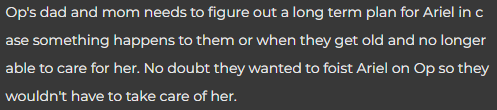
Sophie’s father wrote: “What happens when we die? Will you just leave Ariel and Sebastian all alone?” He meant it as an accusation. It landed as a confession. The question revealed that neither parent had built a single structure for Ariel’s long-term care that did not depend on guilting a daughter they had spent two decades neglecting.
Here is where the story resists a clean reading. Claudette’s delivery was manipulative, her framing was exploitative, and her history with Sophie’s family makes her the least credible messenger imaginable. But strip all of that away and a real question remains: who will help Ariel navigate adulthood? Sophie has no obligation to answer that question. She did not create the dependency, and she did not benefit from the family structure that deepened it. Still, Claudette identified a genuine gap. She just chose to fill it by exploiting the one person she had never bothered to care about.
Sebastian’s absence confirms the pattern. Claudette’s own biological son moved several states away and communicates with Sophie through a system he controls. He calls her. The person raised inside this household ran from it with the same urgency as the person raised outside it.
Best Wishes, Sophie
Sophie signed her email to her father and stepmother with “Best wishes, Sophie.” Not “love.” Not “your daughter.” A closing reserved for professional correspondence and distant acquaintances. That sign-off carries the weight of the entire Reddit half-sister caregiver guilt dynamic compressed into two words. Sophie did not sever a bond in that email. She named an absence that had existed for years.
The emotional register shifts when you notice Sophie’s final reflection. She does not celebrate. She writes: “I don’t have the emotional stability to be around Claudette and Ariel for long periods of time.” That sentence is not a boundary statement dressed in therapeutic language. It is someone admitting they were never given enough to lose. Sophie tagged their numbers to go to voicemail, removed everyone from Facebook, and described the result as feeling “much better now.” Somewhere several states away, Sebastian waited for his turn to call.
How the Thread Read the Invoice
The largest cluster treated Sophie’s refusal as so obvious it barely required discussion. These readers zeroed in on the structural absurdity: a family that never invested in Sophie now expected dividends. The top comment called it a “win win,” and the reply that winning a shitshow still leaves you dirty captured the group’s emotional posture. They celebrated Claudette’s blocking text as a gift, not a punishment. The dominant mood was dry amusement rather than outrage, a collective shrug at a debt collector who forgot to issue the original loan.
A second cluster, smaller but more precise, fixated on the rejected campus disability services. Several commenters noted that Sophie researched the Helpful Handicapped Student Center by name, provided a specific contact person, and watched the entire family ignore it. Professional caregivers and parents of disabled adults populated this group. Their frustration targeted Claudette’s refusal to pursue institutional support, reading it as evidence that independence was never the goal. Transferring dependency was. One commenter with professional caregiving experience laid out the infrastructure that exists for exactly this situation and framed the parents’ avoidance of it as a choice, not an oversight.
A third cluster gathered around the “What happens when we die?” line from Sophie’s father. These readers recognized the sentence as an accidental disclosure of a decades-long plan. Parents of disabled children pushed back against the assumption that siblings owe lifetime caregiving, sharing their own trust structures and transition plans. The emotional register here ran cooler and more analytical. Several described choosing to care for disabled siblings on their own terms and emphasized that the choice itself, not the caregiving, determined whether the relationship survived.
A fourth, quieter thread noticed Sebastian. Readers flagged that Claudette’s own son had already fled several states away, and that Sophie described a “system” for their communication. The detail attracted affection rather than analysis. Commenters wanted to know more but respected the boundary implied by the word itself.
The comment section split along a revealing line. Readers with personal experience of disability caregiving wrote with granular specificity about services, trusts, and long-term planning. Readers without that experience defaulted to snappy one-liners about trash taking itself out. Both groups reached the same conclusion, but the first group arrived angry at Claudette for a different reason: not because she asked, but because she refused every answer that did not involve free labor from a daughter she had never mothered.
This editorial is based on a story originally shared on Reddit’s r/BestofRedditorUpdates community.