Featured on @StorylineReddit: November 18, 2025
A Man Looking for a Crime
Reddit false cheating accusation starts with a man digging through a decade of private messages so he can condemn a betrayal that never happened.
The ugliest part is not that he got the timeline wrong. People can misread old photos. People can panic. What he did instead was turn uncertainty into authority. In one night he appointed himself investigator, judge, and moral expert, then used words like “whre,” “btch,” and “not marriage material” as if insult could stand in for evidence. Even hotel security entering the room did not cool him down. He still tried to keep her there, still argued his case, still behaved like her leaving was the offense.
That is why the later backtrack matters so much. Once she produced the final messages proving the breakup had happened before those photos, he did not land on shame or clarity. He reached for symmetry. “We both hurt each other” is the kind of sentence people use when the facts are no longer on their side but they still want a share of moral ground. Reddit false cheating accusation lands hardest there. The phone search, the wedding language, the nonstop texts, the sudden rewrite. None of it looks accidental.
Reddit False Cheating Accusation in a Locked Room
The structure is brutally simple. He invades privacy first, then manufactures a moral emergency from material he does not understand, then punishes her before any question has been settled. That sequence matters. A partner who wanted clarity could have asked when the engagement ended. A partner looking for leverage does what he did instead: go silent about it “for a long time,” wait for a vulnerable setting, add alcohol, and deliver the accusation as a verdict. The hotel room turns into a closed stage where he gets to define her character while she scrambles to defend a past he has already rewritten.
Her trip to security breaks that script. So does her decision to leave. Still, the update shows how sticky these dynamics are. She already knew he had treated her horribly, yet she still needed the old breakup message in hand. That impulse is easy to understand when someone has spent hours calling you dishonest and disposable. Proof becomes a way to recover your own footing.
Then he does what men like this often do once certainty evaporates. He stops arguing the original charge and starts redistributing blame. “We both hurt each other” sounds calmer than “I violated your privacy, called you degrading names, and was wrong,” so he picks the calmer sentence. It lets him keep a little dignity and asks her to carry some of the stain with him. That move says more about the relationship than the old photos ever could.


He Needed a Crime Before He Needed a Wife
A man who is ready for marriage does not spend an anniversary weekend scrolling back to 2014 so he can build a prosecution file from old texts and photos. He might stumble onto something confusing. He might feel uneasy. But the behavior here has the shape of a search, not a shock. He “went through” her phone, held onto the accusation, then released it drunk in a hotel room where escape was harder and privacy was already gone.
That sequence matters because it shows intent before emotion. He did not ask, “When did you and your ex actually break up?” He announced, “I could never marry someone like that.” Marriage entered the room as a weapon, not a future. The point was not to learn the timeline. The point was to place himself above her and make her beg for moral reentry.
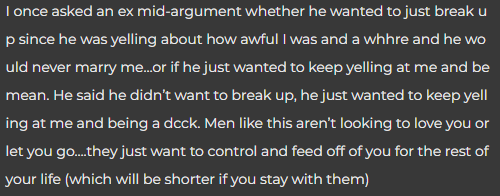
Then the language sharpened. “Whre.” “Btch.” “Not marriage material.” Men reach for those phrases when they want to reduce a person to a category they can punish.
Punishment Came Before Proof
The hotel room becomes clearer if you strip away the old engagement and just look at his method. First he invades privacy. Then he declares guilt. Then he escalates to degradation. Even when security comes upstairs, he is still trying to stop her from leaving, still arguing as if access to her body and attention belongs to him because he feels wronged.
That is why the story does not live or die on whether he was drunk. Alcohol may have lowered the filter. It did not invent the script. Drunkenness does not explain why he had already “known for a long time” and waited. It does not explain the marriage language either. “I could never marry someone like that” is not just insult. It is a ranking system. He casts himself as the man with standards and her as the woman who has failed the exam.
The ugly trick inside that ranking is that it forces her into defense. Once he says “be honest” often enough, the person who has been searched and insulted starts responding like the accused. She is suddenly trying to prove character, not just correct facts.
Reddit False Cheating Accusation as Character Assassination
That is why the phrase Reddit false cheating accusation fits this story so cleanly. The accusation is false, yes. But the deeper violence is how fast he turns a disputed timeline into a verdict on who she is. By the time she is downstairs asking hotel security to help her get her things, he is no longer reacting to a possible misunderstanding. He is using that misunderstanding to remake her into a woman he can despise in public and in private.
The nonstop texts afterward continue the same project. “You’re not marriage material.” “You’re a bad person for leaving me there.” That second line is especially revealing. He insults her, tries to block her exit, gets corrected by security, and then reframes her departure as betrayal. For him, the injury is not that he may have been wrong. The injury is that she refused to stay available while he punished her.
He wanted a captive audience for his moral performance. Once she walked out, he lost the stage.
The Screenshot She Did Not Owe Him
Brief insecurity about old photos would have been human. Calling her a whore and forcing hotel security into the room was a choice.
That distinction matters because some readers will still want to salvage him by pointing to the pictures from early 2015. Fine. Confusion is plausible. Panic is plausible. Even jealousy can be plausible when someone finds fragments of a life they do not fully understand. None of that survives the rest of the record. He did not pause for clarification. He reached for humiliation. When the facts collapsed, he did not say, “I invaded your privacy, I was wrong, and I scared you.” He said, “We both hurt each other and need time to process things.”
That sentence is strategic. It launders blame. Shared pain sounds mature, balanced, adult. Yet the facts are lopsided. He searched the phone. He made the accusation. He used the slurs. She left with security. Later she found the final messages with her ex confirming the breakup and sent the screenshot because she needed the ground back under her own feet.
That need is painfully common. People leave and still want the record corrected. They know the relationship is over, yet some part of them cannot bear to let the lie stand. So they go digging through Google Photos and old texts, not because the abuser deserves an explanation, but because reality itself starts to feel slippery after enough repetition.
His Backtrack Was Not Reflection
The update closes the loophole he was hoping to keep open. Once she proves the timeline, he does not collapse into remorse. He reaches for mutuality. “We both hurt each other” tries to convert his outburst into a tragic misunderstanding between equals. That line also tries to erase the asymmetry of fear. She was the one who asked hotel security for help. She was the one who later locked herself in her bedroom while he slept on the couch. She was the one who kept her phone under her pillow just in case.
Those details strip the romance out of his apology. This was not a lovers’ quarrel inflated by alcohol. It was a control pattern exposed under pressure. She even says it herself in the update, though almost too gently: “It has always been like this.” The phone search did not create the relationship’s problem. It simply gave it a dramatic shape. He had always been looking for a reason to turn suspicion into permission.
So the final proof does not redeem the relationship. It only reveals how little the relationship ever depended on proof in the first place. By the time she sends that screenshot, the real evidence has already been collected: the slurs in the hotel room, the security escort, the barrage of texts, the revision to “we both hurt each other,” and her phone under her pillow while he slept on the couch.
What Reddit Said
The largest cluster read the boyfriend’s behavior as a failed power grab, not a jealous misunderstanding. These readers fixated on the sequence: searching years back through her phone, springing the accusation during an anniversary trip, then trying to recast himself as the injured party once she left. Their logic was simple and hard edged. A person looking for truth asks questions. A person looking for leverage manufactures guilt and waits for the other person to start pleading. The emotional register here was angry, with a strong streak of contempt.
A second cluster came from people who had lived through similar accusation cycles, and their comments carried the most weight because they were not arguing theory. They recognized the pattern instantly: false cheating claims, escalating surveillance, demands for proof, then the slow erosion of the victim’s confidence. Several described staying too long because they got trapped trying to clear their name. That is why they reacted so strongly to OOP going to security and leaving fast. The register here was grieving but practical, with relief threaded through it.
Another sizable group focused less on abuse language and more on trust as a relationship norm. These commenters were not shocked that partners might know each other’s passwords or borrow each other’s phones. They were shocked by the labor of the snooping itself. Going back a decade did not read as curiosity. It read as a mission. Their recurring argument was that access does not create entitlement, and healthy trust usually makes that kind of digging unnecessary. The register was analytical, with flashes of disbelief.
Then there was the cluster drawn to his backtrack, especially the attempt to spread blame evenly after being proven wrong. Those readers treated the later message as the cleanest evidence in the whole post. Once the original accusation collapsed, he still could not tolerate being the sole wrongdoer, so he tried to convert her leaving for safety into an injury against him. Many attached familiar labels to that move, but the shared logic underneath was broader: abusers hate asymmetry when it makes them look guilty. The register was scathing.
A smaller but persistent cluster went one step further and suspected projection. They wondered whether he was cheating, planning to cheat, or looking for an excuse to lower the bar for his own conduct later. That theory was speculative, and plenty of commenters treated it that way, but it kept appearing because readers were trying to explain the sheer effort behind the search. People do not usually excavate eleven years of messages unless they want a weapon.
The comment section shows that readers process stories like this through pattern recognition before morality. They were not debating whether his feelings were valid in the abstract. They were mapping behavior they have seen before, either in their own lives or in other people’s. Once hotel security entered the story and he still tried to keep her in place, most readers stopped treating this as a fight and started treating it as a control script with bad improvisation.
This editorial is based on a story originally shared on Reddit’s r/BestofRedditorUpdates community.