Featured on @StorylineReddit: November 5, 2025
The Purse Was Never the Point
Everyone who reads the hidden nanny cam Reddit post fixates on the camera in the purse, but the surveillance started long before anyone pressed record. The employer built a hiring process stripped of every safeguard a worker might later invoke: no phone interview, no contract, no W-2, no digital profile, a meeting location she controlled. Each refusal removed one more mechanism the nanny could have pointed to and said, you agreed to this.
By the time a nineteen-year-old mother noticed an Alexa flashing green every time she spoke, the infrastructure of deniability had been operational for weeks. Pointed remarks about unwashed fruit and reusable towels were not conversational slips. They were demonstrations of omniscience calibrated to keep the nanny compliant without ever naming the source.
The discovery of the camera confirmed what the employer’s behavior had already established. Yet the aftermath followed its own grim logic: a careful resignation, a paycheck docked to one-third, a Care.com report absorbed without visible consequence. Four days later, a new nanny stood outside the house holding her baby.
Sixteen Dollars and a Hidden Nanny Cam
The hiring process functioned as a filter, but not in the direction the applicant assumed. Every condition the employer imposed selected for someone too financially pressed or too young to push back. A nineteen-year-old who left college to raise a baby and needed income immediately fit the criteria. The $16/hr rate, roughly $8 below market, guaranteed that no experienced nanny with professional boundaries would apply.
Once inside the home, the job expanded until it bore no resemblance to childcare. Dishwashing and floor-sweeping piled onto a role already stretched across three children under six. None of these tasks appeared in any written agreement, because no written agreement existed. The refusal to sign a contract was not eccentricity. It was load-bearing infrastructure.
Surveillance operated on two levels simultaneously. Cameras and an Alexa drop-in captured raw data. But the real leverage came from deploying that data in conversation, referencing details the employer should not have known, watching the nanny absorb confusion she could not yet name. The six-year-old’s rehearsed lines about dirty floors and forgetful people reveal a household where contempt for hired help is ambient. This dynamic did not begin with this particular nanny.
After the camera surfaced, the exit followed a pattern legible to anyone who tracks domestic labor disputes. A diplomatically worded quit. A paycheck slashed without negotiation. A platform report that produced no visible result. Within days, the hidden nanny cam Reddit post had thousands of comments urging police reports and scorched-earth responses. In the same window, a new listing went up, a new hire appeared, and the cycle reset with a fresh participant who had no idea what the purse in the living room was for.


Source
The Architecture of Deniability
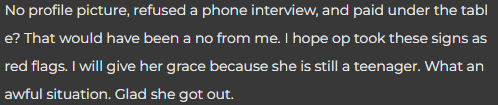
No contract. No W-2. No phone interview. No profile picture. The employer did not forget these things. She engineered their absence.
Each condition she imposed during the hiring process removed a specific form of recourse. A phone interview creates a record. A contract creates obligations. A W-2 creates a tax trail that connects employer to employee in a system with enforcement mechanisms. She wanted cash, refused paper trails, and chose a meeting location she controlled. These are not the habits of someone disorganized. They are the habits of someone who has done this before and learned what to eliminate.
The $16/hr rate performed its own filtering function. At eight dollars below what other families in the area were offering, the listing self-selected for candidates whose financial pressure outweighed their professional judgment. A nanny with five years of experience and a network of referrals would not respond to that post. A nineteen-year-old who dropped out of college to raise a baby and needed income by next week would.
The Contract That Never Existed
When OOP raised the issue of proper employment classification, the employer pivoted to cash and framed her refusal to sign a contract as a preference. But preferences leave room for negotiation. This left none. The absence of documentation guaranteed that every future dispute, over hours, over pay, over what was observed and recorded, would come down to one person’s word against another’s. Given the age and power differential, that arithmetic always favors the employer.
Surveillance Dressed as Conversation
The hidden nanny cam was the bluntest instrument in a system that relied on subtlety. Long before OOP found the camera in the purse, the employer had been converting surveillance footage into casual remarks designed to disorient.
Mentioning that fruit had not been washed. Referencing a snack OOP packed for her own daughter. Knowing about voice-to-text software OOP never disclosed. Each comment carried the same implicit message: I see everything, and you cannot prove how I know. The power of this tactic depends on the target not yet having a framework for what is happening. OOP describes the vibe as “off.” She sensed the asymmetry but could not locate its source, which is precisely how coercive workplace surveillance functions. It produces compliance through confusion rather than through explicit threat.
The Alexa drop-in feature flashing green during conversation collapses any remaining ambiguity. That green light means someone is actively listening in real time. Combined with the camera aimed at the breastfeeding chair, the employer had constructed a monitoring apparatus that covered audio and video across the main living space. She then weaponized the information it produced, not as evidence, but as psychological leverage.
The Six-Year-Old Who Already Knew the Script
Children repeat what they absorb. When the employer’s daughter told OOP that the floors were dirty and needed sweeping, she was not expressing her own opinion about household cleanliness. She was performing a management style she had watched her mother execute on previous employees.
The same child’s comment about her mother being mad, followed by the reassurance that the anger would not be directed at herself, maps a household hierarchy with startling precision. The child understood that anger in this home flows downward and outward, toward hired help, never laterally toward family. She had learned where she stood in the structure and where the nanny stood. That knowledge does not develop from a single bad week. It calculates over months, possibly years, of watching adults cycle through the same subordinate role.
A previous nanny left abruptly. OOP left abruptly. The daughter’s scripted responses suggest she has witnessed enough departures to have internalized the pattern as routine. Her mother’s insistence, sometimes repeated three times in a single conversation, that she is a good person with good morals reads differently against this backdrop. People who are confident in their decency do not rehearse the claim.
Who Pays When Nobody Reports
Thousands of commenters on urged OOP to file a police report, contact CPS, and pursue the employer legally. Several framed the hidden nanny cam Reddit discovery as sexual exploitation, pointing to the camera’s placement at the breastfeeding chair. That framing is understandable but misidentifies the threat. Recasting this as predation treats it as an aberration, one disturbed individual with deviant motives. The structure of what happened tells a different story. This was labor exploitation enforced through surveillance, and it follows a pattern so common in unregulated domestic work that researchers have a name for it.
Calling the employer a sexual predator makes it easier to separate her behavior from the system that enabled it. No platform verification caught her. No labor regulation applied. No enforcement mechanism existed between OOP discovering the camera and a new nanny standing outside the same house four days later. The rage in the comments is real, but rage directed at one person obscures how frictionless the cycle is.
OOP did not file the police report. She explains why: no photos, the employer knows where she lives, fear of retaliation from someone her mother characterizes as a narcissist. These are not excuses. They are a rational cost-benefit analysis performed by someone with no savings buffer, a seven-month-old, and zero institutional support. The commenters demanding scorched earth are spending courage they do not have to budget.
Four days after OOP quit, she drove past the house and saw a new mother holding her baby outside the front door. The purse is probably still in the living room.
What Reddit Said
What the Thread Argued About Instead
The largest cluster treated OOP’s failure to file a police report as the central problem, and the frustration ran hot. Commenters who demanded scorched earth operated from a framework where reporting is costless and institutions respond predictably. Several acknowledged OOP’s vulnerability in theory, then immediately pivoted to insisting she owed it to future victims. The recurring argument was cyclical harm: if you do not report, the next nanny walks into the same house. This logic transfers the burden of systemic enforcement onto the person least equipped to carry it, and almost nobody in this cluster noticed the transfer happening.
A second, smaller cluster zeroed in on the $16/hr rate as the story’s real headline. These readers understood exploitation as structural before it became personal. One commenter calculated that $20/hr in 2010 equals $30 today, making OOP’s rate not just low but historically regressive. The emotional register here was less outrage than disgust at a market that allows this arithmetic to repeat. For this group, the camera was a symptom. The wage was the diagnosis.
The surveillance normalization thread consumed enormous real estate and drifted almost entirely away from OOP. Commenters debated indoor cameras with the energy of people who had been waiting for permission to have this argument. Cat cameras, baby monitors, pet sitters, elderly parents, Afroman catching cops during an illegal search. The conversation functioned as a referendum on domestic recording culture, with a visible transatlantic fault line between American and European commenters. What looked like tangential noise actually exposed the contested norm that made the employer’s behavior possible: if cameras inside homes are ordinary, the line between monitoring and surveilling becomes a matter of disclosure rather than principle.
A persistent undercurrent questioned OOP’s judgment rather than her employer’s. The 24-hour time “red flag” became a punchline across dozens of replies. Readers from healthcare, science, and non-English-speaking countries found it baffling. Several commenters flagged her mother’s armchair narcissism diagnosis as equally suspect. The tone was not hostile but exasperated, the register of people who want to sympathize but keep tripping over details that suggest the narrator does not fully understand her own story.
The comment section split along a fault line that appears whenever a young, financially precarious person posts about exploitation. Readers who have navigated institutional reporting systems urged patience and process. Readers who have not demanded immediate, decisive action and grew visibly irritated when OOP failed to deliver it. The gap between those two groups is the gap between knowing what a police report costs and imagining what it accomplishes.