Featured on @StorylineReddit: November 5, 2025
Love Him, Rob His Partner
A Reddit family steals inheritance from their dead brother’s partner, and every commenter reaches for homophobia as the explanation. The real mechanism is simpler. This family discovered that grief makes an excellent alibi.
OOP’s post opens with a plea for sympathy and closes with a confession of felony theft. Between those poles, every sentence performs the same trick: reframing a choice as a circumstance. They “decided” the money should stay in the family. They “thought” it was unfair. They “didn’t know” it could be serious. Each passive construction hides an active verb: took and redistributed.
“We are not homophobic,” OOP insists, while describing a scheme built entirely on the premise that a gay partner of eight years deserved less than blood relatives who sent him racial slurs. The family never needed to say the word. Their accounting said it for them.
Forget the legal outcome for a moment. The distance between what this family believes about themselves and what the probate court will shortly confirm about their conduct is where the entire story actually lives.
An Inheritance Divided by Committee
The sister did not misunderstand the will. She read it, understood it allocated 85% of liquid assets plus a condo and cars to her brother’s partner, and then distributed the money to relatives instead. OOP frames this as a collective family decision, which is legally irrelevant and morally instructive. An executor’s duty runs to the beneficiaries named in the document, not to a family referendum conducted over someone’s open grave.
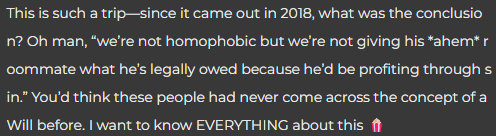
OOP’s shifting justifications arrive in a revealing sequence. First comes the marriage argument: they weren’t even engaged. When commenters dismantle that, the investment argument surfaces: the family supported his business, paid for his schooling. When that collapses too, raw grief appears as the final card. Each replacement lands only after the previous one fails, suggesting none of them were the actual reason. The actual reason quotes directly from the cousin’s post: they could not “reward a homosexual for his sin.”
The Relative Who Broke Ranks
A second post, written by a software-developer cousin outside the immediate family, dismantles the narrative of consensus. This relative describes the redistribution not as a shared decision but as coercion, and openly states a desire to help the surviving partner win his case. That fracture matters more than any legal filing. When a Reddit family steals inheritance and calls it a unanimous choice, one dissenting voice with a clear conscience turns private rationalization into courtroom evidence.
The cousin also surfaces what OOP’s post carefully omits: the family feels no remorse about the theft itself. They regret only the lawsuit.


The Trap Built From Trust
The partner refused to serve as executor. OOP quotes the reason almost offhandedly: “he didn’t want to deal with us” and “he hates us.” That refusal was not petulance. It was a prediction. The partner understood exactly what this family would do with unsupervised access to the estate, and he was correct.
So the sister stepped in. She was, by OOP’s account, the sibling closest to the deceased. That closeness became the lever. The family did not need to forge documents or break into accounts. They needed one person with signing authority and a lifetime of obligation to her parents. The executor role, designed to protect the dead person’s wishes from precisely this kind of interference, became the delivery mechanism for the theft instead.
A Door Left Unlocked on Purpose
Notice the structural irony. The brother chose his sister because she was trustworthy. The family chose her because she was pliable. Both readings coexisted in the same appointment, and only one survived the funeral.
Fairness Recalculated After the Fact
OOP’s definition of “fair” migrates across the like a cursor searching for a field that will hold. The first anchor: marriage. “They weren’t even married let alone engaged.” Commenters point out that wills do not require marital status. The anchor shifts. Now fairness means return on investment: the family paid for school, supported the business. When that framing also collapses under scrutiny, a third version appears, pure and financial: $850K is simply too much for one person who is not blood.
Each justification replaces its predecessor without acknowledging the swap. OOP never revisits the marriage argument after it fails. The investment argument vanishes once someone asks whether parents funding a child’s education creates a lien on that child’s estate. What remains is a number and an emotion: that amount should not leave this family.
The Number That Made Them Honest
The sum itself deserves attention only for what it provoked. At $850K, the family did not pause to consult a lawyer. They distributed the money across an extended family and spent it. The speed of that disbursement tells a cleaner story than any of OOP’s justifications. People who believe they are acting within their rights do not race to make the evidence disappear.
When a Reddit Family Steals Inheritance and Calls It Mourning
Grief appears in OOP’s posts as both shield and credential. “My family is still grieving and now this man wants to take us to court.” The sentence construction places grief and litigation on the same plane, as though filing a lawsuit against someone who stole from you is an act of comparable violence to losing a sibling.
Here is where sympathy for the sister-executor reaches its limit. OOP admits to convincing her. The family applied pressure. But she was not a minor, not incapacitated, not deceived about what the will contained. She read the document, understood its plain language, and chose to override it. Framing her as a victim of family coercion assigns her less agency than the probate court will. A judge will hold her personally liable for the full amount, plus damages, plus fees. That judge will not accept “my older sibling told me to” as a defense, because adults who accept fiduciary duties accept the consequences that follow.
The family’s loyalty, the very bond they invoke to justify the theft, is the force that destroyed her financial future. They protected her from nothing. They conscripted her.
The Crack in the Family Portrait
A month after OOP’s post, the cousin’s account surfaces on the same subreddit. This relative, a software developer with no stake in the estate, describes calling the surviving partner to offer condolences and support. That phone call is a small act with large structural consequences. It confirms that the family’s “unanimous” decision was manufactured through social pressure, not shared conviction.
The cousin quotes a phrase from inside the family deliberations: “we can’t just reward a homosexual for his sin.” OOP’s post never includes that language. OOP insists the family loved their brother and rejects the label of homophobia. The cousin’s account supplies the words OOP’s version carefully edited out.
Remorse and Its Cheaper Substitute
“They are sorry they got caught,” the cousin writes. That single sentence separates two things OOP’s posts work hard to merge: regret about consequences and regret about conduct. OOP’s update promises a family meeting, a plan to repay, a lawyer consultation. Every action oriented toward reducing legal exposure. Not one sentence directed at the partner himself. No apology quoted. No acknowledgment that eight years of partnership entitled this man to grief, let alone money.
The father’s “negative minor racial messages” appear in OOP’s account as a footnote, minimized by the adjective “minor.” The partner received insults throughout the relationship, was excluded from estate decisions after the death, had his inheritance redistributed to the people who sent those messages, and is now described as unreasonably angry for hiring a lawyer. OOP’s final question to Reddit is how to approach this man “without making things worse,” as though the family’s conduct left any room beneath that floor.
What the Thread Said Back
The largest cluster treats the story as a legal comedy performed by people too stupid to appreciate the genre. These commenters fixate on the sheer tactical incompetence: stealing $850K without consulting a lawyer, then posting a detailed confession on a public forum, then expressing surprise at being sued. The emotional register runs gleeful rather than angry. Readers in this group want consequences not because they feel for the partner but because the family’s arrogance demands a punchline. Several express open hope for felony charges, and one commenter’s observation that all the family’s brains died with the brother became a thread-wide rallying cry.
A second cluster zeroes in on the language OOP uses to describe the partner, tracking the steady demotion from “partner” to “boyfriend” to “friend” to “so-called friend” across a single thread. These readers treat the word choices as confessions more reliable than anything OOP says directly. The repeated insistence that the family is not homophobic, placed alongside descriptions of insulting messages and deliberate exclusion, functions for this group as its own kind of evidence. Their anger is precise and lexical. They do not need OOP to admit bigotry; they need only count the synonyms.
A third, smaller cluster focuses on the sister-executor with a fury that outstrips even the response to OOP. For these commenters, the betrayal compounds because the brother specifically trusted her above the rest of the family. She occupied a position of legal and personal privilege and converted both into instruments of theft. OOP’s claim of having pressured her does not soften this group’s judgment. If anything, it sharpens their contempt: she was the one person the dying man believed would protect his wishes, and she folded.
A fourth thread runs through the comments without forming its own cluster: readers who notice the phrase “minor racial messages” and refuse to let it pass. The qualifier “minor” attached to racism functions for these commenters the way “so-called friend” functions for the second group. It reveals a family so accustomed to its own prejudice that gradations of bigotry feel like a reasonable thing to offer a court of public opinion.
The comment section processes this story almost entirely through language analysis rather than emotional identification. Readers do not grieve for the partner; they parse OOP’s vocabulary. That instinct reflects something specific about how Reddit engages with bigotry posted in real time: the words become the crime scene, and every commenter wants to be the one holding the blacklight.
This editorial is based on a story originally shared on Reddit’s r/BestofRedditorUpdates community.