1509 – I [30F] just learned my husband [31M] has feelings for my SIL [29F] and hates my brother [32M]
Featured on @StorylineReddit: November 4, 2025
The Marriage That Was Always a Hallway
A Reddit fake marriage confession rarely begins with the words “our marriage is pretty great,” but the dangerous ones always do.
The poster opens with an inventory that reads like a real estate listing for a house about to lose its foundation. Happy marriage. Close brother. Beloved sister-in-law. Plans for children. Every item on that list survives the story except the one she built her daily life around.
Her husband spent a decade performing partnership while running a proximity strategy. The drunken birthday party didn’t expose a hidden feeling. It collapsed a structure that had been hollow since construction. Jack confirmed everything sober the next morning, then again with fuller specificity the following night. Three confessions in forty-eight hours, each removing another coat of paint from a door that was never locked.
What remains is the blueprint of a marriage that was never built. The poster processed that fact in two days, which says less about impulsiveness than about how little real material there was to grieve.
What the Reddit Fake Marriage Confession Left Standing
Jack’s strategy required sustained, daily performance across a decade. Breakfast conversations, holiday gatherings, discussions about future children. Every interaction with his wife doubled as maintenance of his access route to Kate. The cognitive architecture this demands belongs to project management, not love.
The birthday party functions as a demolition scene rather than a revelation. Alcohol didn’t introduce new information into the room. It removed Jack’s capacity to keep running the program. His flirtation escalated into unwanted physical contact while Kate told him to stop, while her husband told him to stop, while his own wife told him to stop. Three separate people issuing the same boundary, none sufficient. That sequence carries more weight than the love confession that followed it.
Kate occupies a specific position in this narrative: target of a fixation she never invited, filtered through someone else’s account. Her discomfort at the party, her fear in the aftermath. These details arrive as supporting evidence for the poster’s divorce decision rather than as a standalone record of what it means to discover a friend spent years viewing you as a destination.
The poster’s brother delivered an ultimatum that collapsed her timeline. Stay with Jack, lose your family. The story frames this as loyalty. It also eliminated the possibility of a slower, messier reckoning conducted on her own terms. She moved from “our marriage is pretty great” to legal consultation within forty-eight hours, a speed that suggests the marriage contained less substance than its duration implied. Charlie’s protectiveness is genuine. Yet a woman denied agency inside a fake marriage was given a narrow corridor out of it, too.
Jack did not fail at being a husband. He succeeded at something else entirely. For over a decade, he maintained a functioning domestic partnership, discussed future children, navigated the ordinary friction of cohabitation, and performed emotional availability with enough consistency that his wife described the relationship as “pretty great” hours before its demolition. That level of sustained pretense requires organizational commitment. It requires waking up every morning inside a role and executing it with enough fidelity that the audience never checks for a stage.
The Reddit fake marriage confession he delivered across three separate conversations revealed the architecture behind the performance. The first version arrived drunk at Kate’s birthday party. The second came sober the next morning, trimmed of excess but structurally identical. The third, prompted by Reddit comments his wife showed him, filled in the remaining load-bearing detail: he married her to be closer to Kate. From day one.
Each repetition stripped another layer of deniability. Drunk words are retractable. Sober confirmations are not. A full structural confession delivered while reading internet strangers’ speculation is something else entirely: a man watching his own blueprint get decoded in real time and choosing to hand over the remaining pages.
The Bottle Didn’t Build the Door
Alcohol functions as a convenient explanatory device in stories like this. The drunk husband said things he didn’t mean. The substance hijacked his judgment. Readers reach for that framing because it preserves the possibility that the sober version of a person is the real one.
Jack dismantled that framing himself. His sober confirmation the following morning carried no hedging, no minimization. He acknowledged the feelings, called his behavior a mistake, and promised it wouldn’t happen again. But the feelings themselves were not retracted. They were restated as fact, repositioned as manageable. The drinking didn’t generate an alternate Jack. It removed the last functional wall between the performed Jack and the operational one.
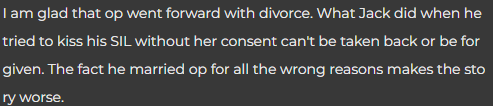
His physical conduct at the party follows the same logic. Kate told him to stop. Charlie told him to stop. His own wife told him to stop. He attempted to kiss and touch Kate anyway. Three boundaries issued by three people in the same room, none of them sufficient. That pattern does not describe impaired judgment. It describes a man who had been restraining himself for years and, for one evening, stopped.
A Person Reduced to a Coordinate
Kate appears in primarily through the poster’s lens: sweet, funny, a great friend, shaken up, considering a restraining order. Her interior life surfaces only at the edges. She told Jack to stop. She feels violated. She doesn’t want to interact with him.
Jack’s obsession required Kate to exist as a fixed point rather than a person. Her qualities mattered only insofar as they sustained his fixation. Her marriage to Charlie mattered only as an obstacle. Her friendship with his wife mattered only as a channel of access. A decade of shared holidays, conversations, and family gatherings, and in Jack’s framework, Kate was never a participant. She was a destination.
The poster reproduces this flattening without malice. Kate’s distress validates the divorce decision. Kate’s potential restraining order signals the severity of Jack’s behavior. Kate’s pregnancy plans offer a hopeful epilogue. In every instance, Kate’s experience serves someone else’s narrative arc. The person most directly targeted by the obsession remains the least fully rendered character in the account of it.
The Corridor Charlie Built
Charlie told his sister that choosing to stay with Jack would end their relationship. He framed this as a principled stance: he refused to maintain ties with anyone who considered Jack’s assault on Kate forgivable. The boundary is coherent. It is also a compression device that eliminated weeks or months of ambivalent processing.
Charlie’s ultimatum accelerated his sister’s clarity, but it also narrowed her options to a binary. Leave Jack and keep your family, or keep Jack and lose everyone. A woman who spent a decade inside a marriage she didn’t know was fabricated moved from discovery to legal consultation in forty-eight hours. That speed has been read as strength. It also looks like a woman who traded one externally structured decision for another. The fake marriage confined her inside Jack’s strategy. The ultimatum confined her inside Charlie’s timeline. Both corridors led somewhere defensible. Neither was self-directed.
This does not diminish the divorce as a decision. Jack’s behavior warranted it independently. But the poster’s own account suggests she knew what she had to do “all along” and was “in denial,” language that frames the ultimatum as a catalyst for pre-existing clarity rather than a constraint. Whether that framing is accurate or retroactive justification is impossible to determine from inside the story.
The Second Theft
The confession didn’t just end the marriage. It reached backward through every year of it and altered the composition. Every memory the poster held of genuine connection now carried a revised caption. The holiday dinners where Jack seemed happy became surveillance opportunities. The discussions about having children became extensions of a cover story. The years of intimacy became a performance log.
This retroactive contamination operates as a second, quieter devastation. The first betrayal took her future: the planned children, the partnership, the shared trajectory. The second took her past. A decade of lived experience didn’t vanish, but its meaning inverted. The poster cannot grieve a real marriage because she never had one. She can only grieve the version she believed was real, which means grieving her own perception as much as his deception.
She closed her update with a list of practicalities. Lawyer. Passwords. Bank accounts. Therapist. And one small, persistent brightness: Charlie and Kate are still trying for a baby, so there’s a pretty good chance she’ll be an aunt in the near future.
What Reddit Said
The Audience Already Knew the Ending
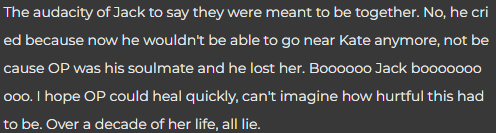
The largest cluster seized on the phrase “our marriage is pretty great” and treated it as a diagnostic marker rather than a statement. Thousands of upvotes gathered around the observation that this sentence, deployed in the opening paragraph of a Reddit relationship post, functions as an involuntary confession. Readers recognized the pattern from dozens of prior stories: the more emphatically a poster defends the relationship’s quality, the more catastrophic the revelation that follows. The emotional register here is not compassion but connoisseurship. These commenters have read enough of these posts to treat the opening self-assessment as a genre convention, a reliable signal that the narrator has not yet caught up with the story they are telling.
A second cluster focused on Jack’s predatory architecture and rejected any framing that softened it. Several readers flagged the poster’s use of “almost predatory” and “borderline assault” as hedging that the facts did not support. Unwanted touching after repeated refusals is assault, not its neighbor. This group read the qualifier as evidence that the poster was still processing the gap between the husband she believed she had and the one who existed. Their frustration carried an analytical edge: they were less angry at Jack than impatient with a linguistic softness they had seen before in stories where victims narrate their own violations in someone else’s vocabulary.
A third, smaller cluster questioned what nobody in the story seemed to ask: why did Charlie send his sister home with the man who had just assaulted his wife and confessed homicidal resentment? Several commenters noted that the poster was arguably the person most physically at risk in the aftermath, yet the protective response organized entirely around Kate. This group operated with genuine concern rather than blame, pointing out that proximity to an unraveling obsessive is a safety problem, not just an emotional one.
A compact fourth cluster treated the timeline with skepticism, questioning whether a high school relationship could plausibly originate as a decade-long infiltration strategy. Their doubt was structural rather than hostile: the story’s internal logic required a teenager to formulate and sustain an access plan across years of daily domestic performance, and some readers found that load-bearing beam unconvincing.
The comment section processed this story the way it processes most betrayal narratives: by competing to identify the earliest warning sign. Readers scrolled backward through the post looking for the sentence that should have been the tell, treating hindsight as a skill rather than a luxury. The race to spot the foreshadowing first reveals less about the story than about the audience. Pattern recognition has become the dominant mode of engagement with these posts, and the commenter who names the red flag fastest collects the most approval, regardless of whether the person inside the story had any realistic chance of seeing it.
Featured on @StorylineReddit: May 15, 2026 The Support System Nobody Authorized Everyone wants to know whether the Reddit aunt displaced […]
Manage Consent
To provide the best experiences, we use technologies like cookies to store and/or access device information. Consenting to these technologies will allow us to process data such as browsing behavior or unique IDs on this site. Not consenting or withdrawing consent, may adversely affect certain features and functions.
Functional
Always active
The technical storage or access is strictly necessary for the legitimate purpose of enabling the use of a specific service explicitly requested by the subscriber or user, or for the sole purpose of carrying out the transmission of a communication over an electronic communications network.
Preferences
The technical storage or access is necessary for the legitimate purpose of storing preferences that are not requested by the subscriber or user.
Statistics
The technical storage or access that is used exclusively for statistical purposes.The technical storage or access that is used exclusively for anonymous statistical purposes. Without a subpoena, voluntary compliance on the part of your Internet Service Provider, or additional records from a third party, information stored or retrieved for this purpose alone cannot usually be used to identify you.
Marketing
The technical storage or access is required to create user profiles to send advertising, or to track the user on a website or across several websites for similar marketing purposes.