Featured on @StorylineReddit: November 6, 2025
Famous on the Wrong Side of the Hallway
Every Reddit high school popularity story gets filed under “peaked in high school,” but this one is actually about two people discovering they attended completely different schools inside the same building. A 25-year-old boyfriend floats the idea that his girlfriend must have swooned over dating the popular football guy. She tells him she didn’t know he existed. He calls her a liar. So she polls her entire old friend group and proves it.
The expected reading writes itself: insecure jock who can’t release his letterman jacket. But OOP refuses that frame before anyone can finish constructing it. She calls her own academic circle “toxic,” admits they ran on a prestige hierarchy just as ruthless as any popularity contest, and insists her boyfriend is not some washed-up cliché. The conflict here isn’t status versus substance. It is two people who shared a zip code for years and never once occupied the same room.
When Reddit High School Popularity Meets a Different Scoreboard
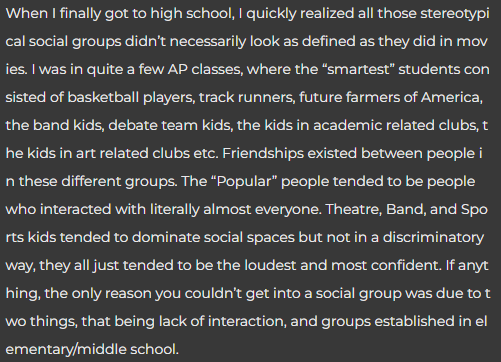
The boyfriend’s assumption carried a logic most people would recognize. Popular kids are visible. Everyone tracks the football players. In nearly every American high school, that model holds without question. His school broke the model without anyone announcing it.
An engineering company relocated dozens of families into a small town and introduced a second social economy overnight. The new students slept four or five hours a night and measured status by college acceptance letters, not touchdowns. They shared AP classes, the same extracurriculars, the same relentless pressure. A closed loop formed around them. The football team existed beyond its edge, not as rivals or outcasts but simply as irrelevant data points.
The Proof-Builder
OOP’s response to being called a liar reveals her wiring more than any description of late-night study sessions could. She did not argue or get emotional. She gathered testimony, polling old classmates until the case was airtight. That instinct to build a proof rather than have a conversation belongs to someone trained in competitive environments where every claim required evidence and feelings carried no weight.
A Daydream Stomped Flat
The resolution reframed everything preceding it. The boyfriend admitted to a passing hallway crush, sparked by a terrible senior photo the school had plastered across its walls and website. His defensiveness never grew from arrogance about his social rank. It grew from a small, private fiction that they had noticed each other from across the cafeteria, a quiet romantic origin story she flattened without knowing it existed. They reconciled easily once that admission surfaced. He asked her never to mention high school again, which tells you exactly how much of himself he had stored there.


Two Caste Systems, One Campus
The town had one high school. It did not have one social world. When an engineering company opened a branch nearby, it imported not just employees but an entire subculture of academic pressure. Their children arrived with GPAs already weaponized, sleep schedules already wrecked, and a status currency that had nothing to do with touchdowns or homecoming courts.
OOP describes this bluntly. The competitive students measured each other by college acceptance prestige and perceived career trajectory. They tracked who got into which program the way sports fans track draft picks. Football players did not register because football players were not applying to the same schools. They occupied a parallel economy with no exchange rate.
Invisible Borders, No Announcement
Nobody drew a line. No one declared the groups separate. The division emerged from scheduling alone. AP classes, academic competitions, and extracurriculars that demanded travel created a closed social circuit. OOP mentions missing more school days than her boyfriend did, not for illness but for club competitions. Two students could share a graduating class of several hundred and never once sit in the same room during the hours that shaped their identity.
The Hallway Crush That Traveled in One Direction
Here is where Reddit high school popularity narratives typically pivot to mockery. The boyfriend assumed he was known. He wasn’t. The crowd laughs. But the update complicates that satisfying punchline considerably.
He had a crush on her. A quiet one, formed from a terrible photo the school plastered on its website after she earned an acceptance that hadn’t happened in thirty years. He watched her from across a hallway she never bothered to scan. When he suggested she must have noticed him, he wasn’t flexing old glory. He was testing whether the feeling had been mutual, even faintly. Her answer demolished a private daydream he had apparently carried for years.
Proof Where a Conversation Should Have Been
OOP’s reaction to being called a liar is revealing in its precision. She contacted old classmates, gathered corroborating statements, and assembled a case. She did not sit with the emotional question underneath his defensiveness. She litigated. That instinct makes complete sense for someone forged in an environment where every claim required evidence and sentiment carried no institutional weight. It also meant she brought a debate-club response to a moment that needed a different kind of attention.
Nobody Was the Healthy One
The boyfriend’s model of high school was not delusional. In the vast majority of American schools, the popular kids are known. Athletes get announced at pep rallies. Cheerleaders perform at public events. Social visibility is the default, not a fantasy. His assumption that everyone tracked the popular crowd was reasonable for almost any school that did not experience a sudden influx of hypercompetitive engineering families. OOP’s campus was the anomaly, not his perception.
Reddit commenters rushed to label him a man stuck in his glory days, which OOP herself pushed back against in . She pointed out that her own circle ran on a hierarchy just as rigid. Students who landed less prestigious acceptances faced a public list stapled to the hallway wall. She calls the environment “toxic” and “unhealthy” without hedging. Four to five hours of sleep a night, relentless internal competition, classmates who “absolutely hated each other.” His nostalgia and her indifference are both distorted lenses shaped by environments that were unhealthy in different directions.
What the Sister Got Wrong
His sister’s complaint that OOP “ruined his memories” frames the problem backward. His memories remain intact. What broke was the assumption that those memories were shared. He can still recall Friday night games and the social warmth of being known. She can still recall the stress and the competition and the singular focus that blocked everything else out. Both versions are true. They simply never intersected until two people who lived them tried to build a love story that stretched backward into a past they did not actually share.
He asked her never to mention high school again. She agreed. Somewhere in that silence sits a terrible senior photo, a mustache, visible eye bags, and the fact that it was the first thing about her he ever noticed.
How the Thread Read Two Yearbooks at Once
The largest cluster treated the comment section as a class reunion nobody planned. Hundreds of readers showed up with their own version of the same story: someone from high school recognized them and they drew a complete blank. A former bully apologized and the target had no memory of the bullying. A classmate greeted them warmly at a bar and they faked recognition for five minutes. These responses carried no anger and very little analysis. They were confessional, almost gleeful, as if OOP had given permission to admit something mildly embarrassing. The emotional register was nostalgic amusement, and the sheer volume suggested that not remembering your classmates is far more common than any high school movie has ever allowed.
A second, smaller cluster zeroed in on school size as the explanatory variable. Readers from graduating classes of 400 or 600 confirmed OOP’s experience without hesitation, while those from classes under 100 pushed back gently, noting that anonymity was a luxury their campuses never offered. This group stayed analytical and comparatively detached. Their interest was structural rather than personal. They wanted to map the conditions under which popularity becomes invisible, treating the story less as a relationship conflict and more as a sociology problem with a sample-size issue.
The third cluster arrived hungry for a villain and left charmed instead. Readers who opened the thread expecting a delusional ex-jock found the update waiting for them like a plot twist in a romantic comedy. The boyfriend’s hallway crush, the terrible photo, his wounded daydream of mutual noticing. Comments here shifted from sardonic to tender in a single sentence. Several readers called the resolution “adorable” or compared it to anime tropes about unrequited attention. OOP herself noted how aggressively commenters had stereotyped her boyfriend before the update landed.
A fourth cluster, mostly self-identified overachievers, confirmed OOP’s description of academic toxicity with an enthusiasm that bordered on competitive. They named rival classmates from fifteen years ago, bragged about sleep deprivation, and treated the thread as proof that their high school experience had been uniquely brutal. The irony of performing the exact behavior OOP described went entirely unnoticed.
The comment section reveals a specific blind spot in how readers process high school stories. Nearly everyone assumed their own experience was the default and used OOP’s post to confirm it. Readers from big schools nodded along. Readers from small schools explained why it wouldn’t apply to them. Almost nobody paused to notice that the boyfriend made the same error: assuming his social reality was the only one operating inside that building.
This editorial is based on a story originally shared on Reddit’s r/BestofRedditorUpdates community.