Featured on @StorylineReddit: November 27, 2025
A Gift Put on Trial
The Reddit destroyed painting boyfriend story starts with a handmade gift and reveals a man who treats money as proof of love while destroying the only thing in the room that actually required care.
A Bioshock painting with him recast as a Big Daddy was not a last minute compromise. It was months of attention from someone rationing rent, loans, and pride. His answer was to ask whether there was a real present behind it, as if labor only counts when it arrives in retail packaging. That detail matters because his insult was not simple disappointment. He called the gift cheap and lazy while standing inside a relationship where her lower income had already become part of how he measured her.
Then the scene gets uglier in a very specific way. He does not just reject the painting. He bends it, crinkles it, and ruins the paint. That action turns taste into punishment. The later details only sharpen the logic already sitting there: the pound of pine nuts, the expensive gelato, the utilities he consumes, the coworker with the bakery cake. His language keeps trying to pass off contempt as financial realism, but it sounds more like a man pricing affection by brand name while quietly auditioning a replacement. The Reddit destroyed painting boyfriend frame holds because the damage was emotional long before it was visible on canvas.
The Price Tag on a Painting
The argument works as a compressed map of the whole relationship. A woman with shrinking income offers the one form of abundance she still controls, which is time, skill, and attention. He answers by ranking thoughtfulness below purchasing power. That exchange tells you how he has started organizing intimacy. In his version, paying for groceries and utilities does not create shared stability. It buys him the right to judge her effort, her budgeting, even her legitimacy as a partner.
His cruelty also has the strange, overdone quality of someone trying to force an outcome. The comparison to the coworker was too pointed, too polished, too ready. Red velvet cake from the favorite bakery is not random birthday trivia. It is evidence entered into court. He is building a case that another woman understands his tastes better, earns more money, and therefore belongs in the role more convincingly. The painting becomes useful to him because he can convert it into proof that he has been deprived.
That is why the confession fits so neatly once it arrives. The affair does not interrupt the birthday fight. It explains the choreography of it. He wanted her to absorb the disgust, react first, and spare him the work of naming himself as the one leaving. Even his apology comes back in a dollar store frame, a gesture so small and insulting that it barely qualifies as repair. The breakup lands only after she stops treating the outburst as a mystery and starts reading it as strategy. Once that shift happens, his money talk stops sounding practical and starts sounding like camouflage for cowardice.


The Reddit Destroyed Painting Boyfriend Wanted a Receipt
He asked whether the painting was the present or whether there was another one behind it. That line lands harder than the insult that follows, because it shows the metric before the tantrum. A gift made over months, tailored to his favorite game, with him painted into the scene, does not even enter the category of serious effort unless it arrives with a retail price tag. He is not reacting to bad taste. He is reacting to the absence of market value he can point to.
That is why the bent canvas matters more than the usual birthday fight language. He does not toss it aside. He damages it with his hands, enough to wrinkle it and ruin the paint. The action carries a child’s logic and an adult’s spite. If her labor does not count as value, then he feels licensed to treat it like paper. The thing she made becomes the thing he can crush.
A lot of people read the scene as a rich boyfriend being shallow. It is uglier than that. He needs the gift to be illegible as love because accepting it would force him to admit she paid attention in a way he no longer wants to reciprocate.
Groceries, Utilities, and the Moral Theater of Spending
His complaints about money arrive dressed as fairness, but the details keep giving him away. She pays half the rent on an expensive apartment, covers her student loans, and has already taken a worse job after losing the better one. He buys pine nuts by the pound, keeps expensive gelato in the freezer, runs heat and AC aggressively, and uses enough electricity to turn a shared bill into a recurring fight. Then he reframes his own consumption as generosity because he agreed to cover groceries and utilities.
That arrangement did not bother him when it helped stabilize the apartment. It bothered him once he wanted emotional leverage. So he converts contribution into status. Suddenly he is the serious adult subsidizing the careless partner, even though the story he tells about her “extra cash” collapses on contact with the facts. There is no extra cash. There is a woman trying to keep up with rent and loans while he eats handfuls of pine nuts like a bored prince.
The contempt has a class accent to it. Cheap. Lazy. Bad at budgeting. After a while those words stop sounding like complaints about a birthday and start sounding like an attempt to downgrade her entire place in the relationship.
Red Velvet Was Already in the Room
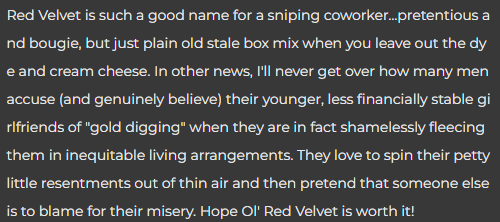
The coworker enters the argument long before the confession. She appears as evidence. She bought his favorite cake. She knows the right bakery. She earns more money. None of that surfaces by accident. He is arranging another woman beside his girlfriend and asking the comparison to do the humiliation for him.
Then the affair admission snaps the scene into focus. They kissed after drinks. Then it was not just a kiss. Then they had been going on little dates during work hours and were basically in a relationship. His birthday explosion stops looking impulsive the second that sequence appears. He was not simply angry about a present. He was already living halfway in another attachment and trying to turn disgust into an exit strategy.
That is where the analysis has to get less polite. The cheating is not the most revealing part of the story. His insistence that paying more gives him authority to define thoughtfulness is worse. Affairs happen in messy, cowardly, common ways. His financial logic is colder. It says love only counts when it is purchased at the correct level, by the correct class of woman, with the correct polish. Once a person starts thinking like that, the affair barely feels like a deviation. It feels like product selection.
For context, she links readers back to the with the sketch offer and the ruined painting still hanging over everything like a dare.
He Wanted Her to Do the Breaking
He admits this almost plainly. Part of the painting fight was resentment. Part of it was wanting to hurt her enough that she would break up with him. That sentence reorganizes everything that came before it. The bakery comparison, the rant about money, the destruction of the painting, the overnight disappearance under the flimsy cover of Easter brunch and borrowed work clothes from his father. He wanted to create conditions so intolerable that she would perform the decisive act and let him keep some illusion of passivity.
Even the attempted repair carries the same pettiness. He brings the painting back in a cheap dollar store frame, wrinkled and flaked beyond repair, as if enclosure might substitute for remorse. That object is almost funny in its meanness. Not because the situation is light, but because the gesture is so embarrassingly thin. He wants credit for returning the evidence after he already destroyed it.
Cowardice often tries to look practical. That is what his money speech is doing. It gives him a vocabulary that sounds adult and managerial while he behaves like someone kicking furniture to avoid saying he wants out.
Why She Kept Looking for the Missing Reason
She spends a long stretch of the conflict trying to locate the hidden cause. That instinct can look naive from the outside, especially after the comments mention the muffin thrown across the room and the line to her grandmother about thinking she was dead already. But her search for an explanation follows the structure he built. He kept insisting that something external was wrong: budgeting, groceries, a bad gift, a misunderstanding about who pays for what. If the problem sits out there, then the relationship might still be repaired by solving it.
And she had material reasons to hesitate. A lease with three months left. Lower income. Shared housing. Student loans. The practical trap sits right next to the emotional one. People stay in bad arrangements longer when leaving comes with invoices.
Once he says he wanted her to end it, her confusion hardens into anger and then relief. Not relief because the betrayal softens him. Relief because the nonsense finally lines up. She no longer has to keep translating cruelty into stress, or class contempt into concern, or sabotage into a communication problem.
The final image suits him perfectly. Not the affair. Not the cake. Not even the dollar store frame.
A pound of pine nuts a week.
What Reddit Said
The largest cluster read the boyfriend less as a cheater than as a coward running an outsourced breakup. Commenters kept circling the same logic: wanting out is ordinary, but manufacturing misery so the other person does the leaving is a special kind of moral laziness. That is why so many replies latched onto the idea of “relationship chicken.” People were not shocked by infidelity alone. They were irritated by the choreography of it, the way he escalated cruelty, floated the coworker, then waited for her to pull the trigger. The emotional register here was angry with a streak of grim recognition.
A second cluster formed around handmade labor and the insult embedded in destroying it. For these readers, the painting was not just a present. It was concentrated attention, tailored to his favorite game, made by someone with very little money and a lot of care. Artists, knitters, crafters, and gift givers responded almost physically to that detail because they recognized the hours inside the object. Their recurring argument was simple and sharp: trashing a handmade gift is a declaration that the maker’s time has no value. That group was smaller than the breakup-cowardice crowd, but it carried the deepest hurt. The register was compassionate, bruised, and intensely personal.
Then came the testimonial cluster, where readers folded the story into their own histories. People described former partners who became suddenly harsher, invented surreal excuses, or treated cruelty as a campaign tactic until the relationship finally collapsed. Those comments did not just agree with the post. They used it as a template for naming patterns they had once struggled to name in real time. Several replies showed how long this strategy can keep someone confused, because the target keeps assuming the behavior must have a hidden reason that can still be fixed. The register here leaned grieving, with flashes of bitter humor.
A fourth cluster blended class resentment with mockery. Readers fixated on the boss’s son angle, the self-importance, the bakery comparison, and of course the pound of pine nuts a week. That detail became comic shorthand for a man whose appetites had outgrown both humility and proportion. Humor was doing real work there. It reduced his grandiose self-image to a greedy little habit, which is often the fastest way a comment section strips a petty tyrant of his costume.
The comment section treats stories like this as pattern recognition, not debate. Readers do not spend much time weighing both sides when contempt becomes this concrete. They move fast to classification: coward, status snob, affair rehearsing in public, man too spineless to leave cleanly. Then they stabilize each other with jokes, craft talk, and their own old wreckage, all while that ruined painting sits in its cheap dollar-store frame.
This editorial is based on a story originally shared on Reddit’s r/BestofRedditorUpdates community.